Showing posts with label Downloads. Show all posts

Sunday, 5 November 2017

Baby, You're a Firework

Everyone loves fireworks. On Saturday night I went to the huge display at Alexandra Palace, an annual event that is prompted by the anniversary of Guy Fawkes’ attack on British parliament, albeit that Fawkes and politics are curiously absent from the celebrations these days. There were thousands of people there. It was one of those rare occasions where you see a true cross-section of London’s population: all ages, all sexes, all sexualities, all nationalities, all races and all faiths. There’s a problem with fireworks displays, though. The first explosions are always astonishing, but how do you sustain attention over a 20-minute set? It can all start to seem a bit tedious and wasteful. At worst you feel like Aimee Mann in her song '4th of July', which commemorates America's fireworks night: ‘Today's the fourth of July / Another June has gone by / And when they light up our town I just think / What a waste of gunpowder and sky’. You know that there will be a climax at some point, but climaxing is about the only thing that fireworks know how to do.
            There is an answer to this fireworks conundrum. Why not try dancing to them? Dancing is always interesting. It can be enhanced, further still, by visual effects. The Alexandra Palace festival was sound-tracked by DJ Yoda. He was brilliant, weaving together short bursts of music from a large array of genres. He was also thoroughly modern with his faith in the past. Yoda knows the musical state of play. After 15 years of downloading services and a decade of Spotify, there is an audience that knows a huge amount of music and is open to all types. You can play anything from any era as long as it’s good and it’s right. And so we had songs drawn from the 1950s to the present day, and from styles as diverse as hip-hop, folk music, trance, post-punk, jazz-funk, soul, movie soundtracks and mainstream pop. We danced to Deodato’s version of Also Sprach Zarathustra and we danced to the Beastie Boys’ ‘Intergalactic’. The biggest hits of the night were a remix of the Weavers’ ‘Wimoweh’ from 1952 (a song, it seems, that we have all grown up with) and a brilliant segue of New Order’s ‘Blue Monday’ (from 1983) into Rihanna’s 2011 hit ‘We Found Love’ (the trance clichés of this track are irresistible). Of course the whole thing ended with Katy Perry’s ‘Firework’. Except it didn’t. There was an encore sequenced to ‘Feelin’ Good’, Nina Simone’s classic from 1964. These are great times to be a DJ. And they are great times for explosive dance.  

Sunday, 31 January 2016

Reformatted Again

My review of Andrew Leyshon’s book Reformatted: Code, Networks and the Transformation of the MusicIndustry is available in the January 2016 edition of Popular Music.
            Reformatted is a decent book but much of it is dated. It is largely compiled from journal articles that were published between 2001 and 2009. This is of interest in itself, as we get to see the preoccupations of the music industries in the recent past. What is missing is as significant as what is present. Leyshon was an early chronicler of downloading. He states that he was fortunate that internet file sharing was brought to his attention ‘when it still remained below the horizon of most economic commentators, let alone social science researchers’. He has not always been a visionary, however. When he talks of the industry being ‘reformatted’, he envisions it being remade in the shape of a download. This book fails to predict the impact of streaming.
            It would be unfair to single out Leyshon in this respect. There have been numerous books written about music technology in the last 15 years, each of them taking pride in their modernity and each of them concentrating on downloads rather than streams. People from the music industry too, seemed to view the rise of Apple as inexorable.
            So did anyone other than Daniel Ek envision that we would be reformatted again? I have been thinking back to my PhD interview, which took place in 2004. My original proposal was for a project that would explore the differences between analogue and digital formats; I told the interview panel that I planned to investigate vinyl and downloading. My supervisor, Steven Connor, responded that I should look at vinyl and streaming instead. In his opinion it clearly represented the future of music consumption.
            Steven Connor is nominally a Professor of English. Really, he is a polymath. Even so, how come he was so prescient about streaming when most of those studying the music industries had less foresight? I recently quizzed him about this and he replied by suggesting that ‘everybody was assuming at the time that anyone who could get the streaming model to pay was going to clean up’.
            I think he is being modest here, but there is also truth in what he is saying. There certainly were people who visualised the success of streaming at this time. And then iTunes came along. Its rampant success had a hypnotic effect. My PhD interview took place in March 2004; iTunes was launched in the UK in June of that year.

Friday, 8 January 2016

The Single Goodbye

Ten years ago, when I was working on my PhD, I would regularly bump into Travis Elborough in the British Library. Little did I realise that we were exploring similar themes. I was writing my thesis about vinyl, which in adapted form became my book. Travis was also investigating recording formats. He believed that iTunes was destroying the album as a source of income and a ‘thing’. The fruits of his labour became The Long-Player Goodbye, which was published by Scepter in 2008.
            His predictions have not necessarily come true. 159m albums were sold in 2005. This figure was for physical formats only, as the download album was not yet generating any income. The British Phonographic Industry (BPI) published the sales figures for 2015 yesterday. They claim that there were 122m album sales last year. While this represents only three-quarters of the sales of a decade ago, it is probably more than anyone expected. Travis, for example, had suggested that the album appeared to be ‘severely imperilled’. But rather than being at risk, the album has revived. The sales figures for 2015 were up 3.7% on the previous year.
            Or at least that is how the record industry has chosen to present things. When we look more closely at the figures we find that genuine ‘albums’ - a collection of songs that a user purchases or consumes as a combined body of work - are not doing so well. CD sales are surprisingly resilient, but they are definitely not increasing: at 55.8m they were down 3.9% on the previous year. Digital albums are faring worse. Standing at 25.7m, they were down 13.5%. Back in 2008, Travis had glimpsed stirrings of a vinyl renaissance, describing it as a ‘peculiar rearguard action’ in the face of the defeat of the album. It is now more than that. In their report on the 2015 sales figures, the BPI note that vinyl was facing ‘near extinction’ in 2007, but its ‘fairy tale revival’ has seen sales reach a 21-year high. 2.1m units were sold last year, an increase of 66% on 2014. This does, however, still represent less than 2% of music consumption in the UK. In total, these formats accumulated 81.5m sales. This was five million fewer than the previous year, and just over half the albums figure for 2007.
            How, then, has the BPI reached its total of 122m album sales? First, they have quantified all individually downloaded tracks as ‘album equivalent sales’. Each download is only allowed to represent a tenth of a purchase, however, in deference the average number of tracks an album. In addition, each individual stream is counted as an album sale. These are divided by a thousand, in accordance with a ‘standard music industry metric’: ‘100 streams = one track sale and 10 track sales = one album’. Using these calculations, individual downloads were equivalent to the sale of 13.3m albums in 2015. Although this was down 14.7% on the previous year, any shortfall was more than made up by the popularity of streams. These were equivalent to the sale of 26.8m albums, a huge 81.7% increase on 2014.
            These mathematical shenanigans are not to everyone’s taste. Tim Ingham, founder of Music Business Worldwide, has described them as ‘self-evident madness’. I don’t think that Travis would approve of them either, albeit that they do provide evidence that some of his hunches were right. These ‘equivalents’ have helped to crack open ‘any notion of the album as linear, unalterable whole’.
            The larger question, however, is why should the record industry want to present every use of music as an album sale. Economics surely come into it. These figures help to downplay the popularity of streaming. This is useful in a climate when the low royalty income from streams is widely criticised. There were 26.8bn individual audio streams in the UK last year, as opposed to 81.5m physical and digital album sales, and yet despite this vast traffic streams are only generating around a third as much money (£251m as opposed to £687m, according to the BPI’s figures, which due to the low income from ad-supported services only feature the income from streaming subscriptions). The division by 1,000 makes this income appear just, as streams represent a third of physical and digital album sales when employing the ‘equivalent’ calculation. However, the BPI’s streaming figures are not only divided by a thousand, they are also halved. They fail to include the 26.9bn streams of music that took place through video sites. This includes YouTube, the most popular provider of music in the UK.
            If these figures tone down the popularity streaming, they also boost the importance of physical formats. When the equivalents are in place, the CD emerges as the leading product. In addition, vinyl’s percentage increases enable this format to be widely praised. It remains important for the record companies to promote these products, as this is where their main profits lie. The companies may well be deriving more income from streaming services than their artists do, but those royalties are dwarfed by the money they rake in with the sale of vinyl and CDs. Tim Ingham has calculated that Adele’s 25 would need to have been streamed 16.4 billion times to equal the $115bn it has thus far generated via physical formats and download sales.
In some cases, however, it costs the industry money to describe products as albums rather than as singles. Simon Fuller’s company 19 Recordings has taken their parent label Sony Music Entertainment to court, alleging a number of contractual misdemeanours. Among them is the fact that Sony regard individually downloaded tracks as singles, whereas 19 Recordings believes they should be classified as ‘segments’ of albums. These definitions have financial consequences, derived from the days when all records were physical, as the plaintiff’s case makes clear:
Because of the high costs of promoting the ‘single’ to radio as well as the relatively high costs of manufacturing, and distributing and marketing it to the ‘brick and mortar’ retail stores that then existed in comparison to those comparable costs expended on an Album, virtually all record labels historically paid lower royalty rates to artists on this less profitable ‘singles’ product. In contrast, the Album, with its relatively small incremental additional costs to manufacture and distribute, but with its 3 to 4-fold higher selling price, permitted labels to achieve a substantially higher profit margin in comparison to the ‘single’, and thus the labels were able to pay a significantly higher royalty rate on albums, including escalations in that rate based on sales success since those profit margins only increased as sales volume went up.
Sony has paid 19 Entertainment a royalty rate for singles that is 25%-35% lower than their album rate. The album rate has the further advantage that, if worldwide sales of 1m are achieved, the royalty increases.
Fuller’s company is furious at the treatment they have received in the download world. First, Sony Entertainment has allowed iTunes to ‘disaggregate’ albums without 19 Recordings’ permission, thus making all tracks available individually. Second, Sony have claimed that these individual tracks should be paid at the reduced ‘records other than album’ rate. Third, Sony are not allowing the sales of these individual tracks to count towards ‘the equivalent of the sale of one Album ... for purposes of calculating sales escalations on that Album’. Consequently, 19 Recordings believe they are being cheated in respect of some ‘albums’ whose disaggregated tracks total the equivalent of 1m sales. There is much in 19 Recordings’ argument. In the online world the costs of manufacture and distribution cannot be used to justify a lower royalty rate for singles. Moreover, the fact that trade bodies are keen to report all online activity as ‘segments’ of albums should surely help 19 Recordings cause.
Given these royalty implications, there must be reasons beyond the financial why record industry personnel remain so devoted to albums. One explanation, perhaps, is that they are not so different to Travis Elborough: they admire the beauty of the LP. This is not as fanciful as it may it first appear. The industry’s major awards, whether these are Grammys, Brit Awards or Mercury Prizes are for albums, and these are (supposedly) based on artistic merit, rather than upon sales. The artists that the industry admires most are those who consistently make important albums. It has commonly accorded greater merit to rock than to pop. Simon Cowell, from this perspective, is not an industry mastermind; he instead suffers from the industry’s snobbery – his artists are consistently frozen out from the most important industry awards.
Of course, these values are as financial as they are artistic. One of the reasons why the record industry praises rock artists over pop artists, and album sales over single sales, is because it is here that longevity lies. And with longevity lies profit. Development costs are paid off and break-even points are achieved. Nevertheless, it is not only consumers who value ‘product’ for its aesthetic worth. Industry personnel work best when they are promoting music they admire. They can also appreciate the beauty of the product itself: industry figures are capable of being spellbound by the look and feel of LPs. Tony Wadsworth, who retired as chairman of the BPI last year, left his post to help set up a vinyl-only branch of the record shop Sister Ray.
There is one further reason for the industry love of albums that mixes the financial with the emotional: patriotism. In 2015, seven of the 10 best selling albums artists were from Britain. In 2014, all 10 were British, the first time this had happened. The situation is different for streaming. The ten most popular streamed tracks in 2015 came from a variety of sources, with only a third of the artists hailing from the UK. This is reflective of a longer historical pattern. For the past ten years the best selling album in Britain has been by an artist from the UK, but the singles charts have been more international. The trade figures issued by BPI downplay the importance of singles by only reporting album sales and album equivalent sales. The triumph of international artists in the singles charts has been decimated, and it has been reduced by a thousand when it comes to streams. Meanwhile, the triumph of British artists in respect of conventional album sales is left to stand as it is. Overall, by kissing the single goodbye and recalibrating streams and individual downloads as albums, these trade figures promote the locals and give a lower profile to the foreigners. The British Phonographic Industry is putting British music first. 

Wednesday, 21 October 2015

I’ve Been Making Available All My Life

In recent blog entries I have been taking a look at the recording and publishing industries, as well as at mechanical and performing rights. Mechanical rights, which are also known as reproduction rights, incorporate the right to copy a work and the right to issue copies of a work to the public. Performing rights encompass the right to perform to work in public and the right to communicate the work to the public, which includes broadcasting.
In ‘Adding Up the Publishing and Recording Industries 2014’ I stressed the monetary importance of performing right for both songwriters and recording artists. Under PRS for Music rules, songwriters are automatically entitled to 50% of income whenever their song is licensed for performance, whether this be in a live setting or via a broadcast. Similarly, under the ‘equitable remuneration’ rules operated by PPL, recording artists are entitled to 50% of income whenever their recordings are played in public premises or are broadcast on radio or TV. In both cases these royalties are safeguarded: they cannot be recouped from advances.
In ‘Broadcast Y’Self Fitter’ I stressed the difference between classifying digital income as a performance or a mechanical right. If it is regarded as the former, being considered more akin to broadcasting, then artists as well as songwriters can be entitled to as much as 50% of the royalties. If it is regarded as the latter, being instead associated with physical recordings, the recording artist’s royalty rate can drop to something like 15%.
            I’m not alone in having this interest. Since uploading my last blog entry, the Music Managers Forum has published Dissecting the Digital Dollar: How Streaming Services are Licensed and the Challenges Artists Now Face. It is an important document, providing a detailed and lucid account of copyright and royalties in the digital age. It also provides further detail for the case that I have been making.
            One of the best ways to highlight injustices and inconsistencies in respect of royalties is to compare the activities of the collection societies, publishers and record labels. Publishers’ collection societies view the broadcasting of songs as involving both a mechanical and a performance right. In Britain, both the Performing Right Society (PRS) and the Mechanical-Copyright Protection Society (MCPS) have collected income for radio broadcasts. The performing and mechanical rights are present for online licensing as well, whether this is for online radio, downloads or streams. Consequently, the umbrella society, PRS for Music, operates joint licences to capture both of these forms of copyright.
There are differences in the way that income is divided, however. Perhaps understandably, as the format has an affinity with the sales of records in record shops, downloads are regarded as being more mechanical: 75% of royalties collected under the relevant joint licensing scheme go to MCPS and 25% to PRS. Online radio witnesses the reverse: 75% of income goes to PRS and 25% to MCPS. Again, this is understandable, as radio leans more towards the communication right that is enshrined in PRS activity, than it does towards the right to copy, which is patrolled by MCPS. Streaming sits in between: here the money from joint licensing is divided 50/50 between MCPS and PRS. These splits have implications for songwriters. They might receive similar overall shares in each area: for example, both the mechanical and performance income could be divided 75/25 between artists and publishers. As stated above, however, it is only the performance income that is safeguarded against advances: 50% goes directly to the songwriter and cannot be recouped.
If the recording world were to have parity with music publishing, streaming would be regarded as having an equal split between mechanical and performing rights. It would then follow that record companies would collect the 50% of the streaming royalty that relates to the mechanical right themselves. From this income, they would pay their recording artists a similar royalty to their income for physical sales: this would result in a new recording artist receiving an approximate 15% share. The recording artist should do better when it comes to the performing right. 50% of streaming income would be collected by the relevant performing right society, which in the UK is Phonographic Performance Ltd (PPL). This income would itself then be split 50/50, with half going to the record company and half to the recording artist.
But this doesn’t happen. Record companies collect the whole of the streaming income. According to PPL’s own literature, the labels regard both downloading and streaming as involving the mechanical right only. Their 2011 Annual Report states:
PPL’s online revenues remain limited as the majority of online sound recording licensing is carried out directly by rights owners. This reflects the prevailing view of record companies that downloading and on-demand streaming is analogous to the distribution of sound recordings, a traditional record company function.
Running somewhat counter to this argument, the record companies’ also claim that recording artists are not entitled to ‘equitable remuneration’ when it comes to downloading and streaming because this is an area in which performing rights operate differently.
            Here they refer to the ‘making available’ right, which was formulated during World Intellectual Property Organisation treaties of 1996 and enshrined in EU law in 2001. Dissecting the Digital Dollar outlines the origins of this right:
the communication control, where defined in copyright law, traditionally related to conventional broadcasting which, while easily extended to webcasting, might not apply to other kinds of digital transmission. To ensure digital communication of this kind would still be restricted by copyright, and perhaps to distinguish it from the existing controls that covered broadcasting, some rights owners lobbied to have a separate control added to copyright law called ‘making available’.
The activity controlled by this law is ‘electronic transmission in such a way that members of the public may access the recording from a place and at a time individually chosen by them’. As such, it clearly encompasses downloading, but does not encompass online radio (as a result online income in this area is collected by PPL). The record companies believe that the ‘making available’ right encompasses streaming as well. However, as the MMF report states, ‘not all artists agree’ with this point of view. As illustrated by the way that the publishing sector deals with streaming income, this activity can be regarded as akin to both broadcasting and to record sales.
            Why does any of this matter? ‘Making available’ is the only area of sound recording performance rights that is exempt from ‘equitable remuneration’. Consequently, artists are not guaranteed 50% of this income. Instead, it can be collected by record companies directly and some artists will therefore be on a standard royalty rate as low as 15%. What is more, any royalties collected can be recouped from advances.
            Dissecting the Digital Dollar includes a survey conducted with artist managers. Their responses to two questions are particularly telling. 78% of respondents believed that equitable remuneration should exist for all digital services, including both downloads and streams. However, when asked if they know how collection societies proportion streaming income according to the mechanical right and the performing right, only 3% replied in the affirmative.  

Monday, 5 October 2015

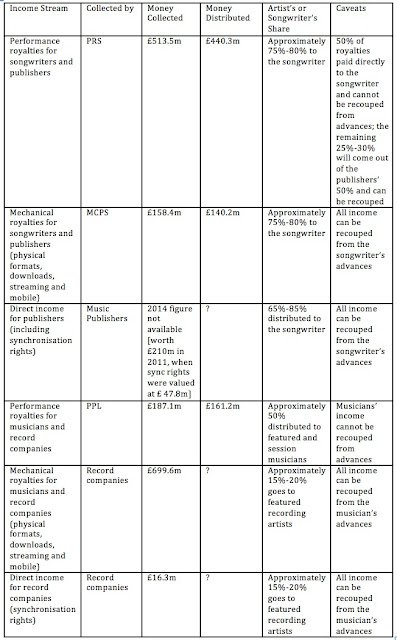
Adding up the Publishing and Recording Industries 2014

Following on from the previous two blog entries, which took a comparative look at UK collection societies and the income earned by live and recorded music, I’ve made a stab at presenting UK recording and publishing income for 2014.
           The statistics come from a variety of sources and it is risky to contrast them in this manner. In addition, I don’t have privileged access to information. What the figures should help indicate, however, is the relative health of each area. I’ve also made a stab at indicating what proportion of money will go to the songwriter or performing artist albeit that, unless the money is paid to them directly by a collection society, there are plenty of deductions and reductions that can be added to the percentages given in the final column. Significantly and spitefully, I have left out the money from live music, other than performance royalties that PRS collects for songwriters and publishers.


While the collection societies and the British record industries’ trade body BPI are reasonably good at indicating the money that has come into the UK, they are less forthcoming about the money that is leaving. The PRS, MCPS and PPL figures include income that is derived via reciprocal links with foreign collection societies, but they fail to state how much is going in the opposite direction. We don’t know how much money is going to foreign songwriters, publishers, record companies and musicians. Moreover, the record company figures also say nothing about the nationality of the musicians who will be receiving the royalties, nor do they mention the record companies’ countries of origin.
            According to Will Page, there was a time when publishers’ income was divided 40:40:20 between performing, mechanical and synchronisation streams. The figures above would indicate that the split is now divided something like 70:22:8. While this new division highlights the decline of record sales, it distorts the income that can be made from sync rights, which in overall terms has risen considerably in the past few years. In fact, the £47.8m figure given in relation to songwriting sync rights seems like a conservative reckoning, as does the £16.3m for sound recording sync rights. The latter figure comes from IFPI, but in 2011 BPI were regarding this income as nearer to £22m.
While the mechanical royalties for songwriters and publishers are certainly declining, these figures show them to be in better health than some PRS for Music information would have us believe. The PRS for Music Financial Review for 2014 lists recorded music as being worth £63.1m. The higher figure of £140.2m quoted here comes from MCPS’s own Report and Statements and includes the mechanical income that is derived from online licensing and broadcasting income.
            PRS and MCPS generally operate joint licences when it comes to online income (there are also a few minor income streams that are jointly licenced between PRS and PPL). There are no figures available to show how this income is split: PRS for Music instead publish a total figure of £79.7m. This figure is around 22% of the £363.8m that record companies derive from downloads (£249m) and streaming (£115m). The proportion of this money that makes its way to performing artists is much debated.
            But how much money in royalties is going to songwriters and artists overall?  A final, admittedly rough, outcome would reveal something like the following:
  • Performance royalties for songwriters: £374m (roughly two-thirds of which is non-recoupable)
  • Mechanical royalties for songwriters: £119m (recoupable)
  • Sync rights for songwriters: £33m (recoupable)
  • Performance royalties for musicians: £81m (non-recoupable)
  • Mechanical royalties for musicians: £122m (recoupable)
  • Sync rights for musicians: £3m (recoupable)
The money’s in the publishing; it is also in performance.

Wednesday, 26 March 2014

Karl Marx and the Hot 100


America has done it, Norway has done it, Sweden has done it, Germany has done it. The UK is still making its mind up.
            The big decision is whether to include streaming data when compiling the singles charts. This is tougher for the UK than the US. The principal American chart – the Hot 100 – was founded by Billboard in 1958. It has always been more than a sales chart. From its outset it has been made up of airplay statistics alongside sales data. Since 2012 it has also included audio streaming figures, and since February last year it has included statistics from YouTube, the world’s biggest music distributor.
            The UK’s music chart was first complied by NME in 1952 and has changed ownership several times since then. One thing has remained constant, however. In the UK it is the sales of recording formats that are counted, whether these have been shellac records, vinyl, CDs, cassettes or downloads. If the current governing body, the Official Charts Company, were to incorporate streaming figures, they would be making a fundamental change. As well as mixing up sales and streams, they would be collating exchange-value and use-value.
            What’s the difference? For Karl Marx, use-value is the ‘utility of a thing’, but when items are commodfied and sold, ‘their exchange-value manifests itself as something totally independent of their use value’. In the past, the UK charts have quantified exchange-value only. They have counted the number of times an item is sold rather than how often it is used. And when it comes to downloads or physical formats they will continue to do so. Streaming is different. The Official Charts Company isn’t going to examine Spotify or YouTube’s monetary transactions. If they are to include streaming figures they will do so in the same manner as America, Norway, Sweden and Germany: they will count the number of times a song is played.
            Why does any of this matter? Well, Marx is right: exchange-value is independent of use value. In the past, the British charts have been distorted by the games that can be played with physical formats. The commodification of music has enabled record companies to build up artificial demand. Records have gained high chart positions because of their special features (coloured vinyl! picture discs! posters!), because they are available for a limited time (buy now while stocks last!), or because they have been discounted (£1.99 for one week only!). These records might sell in large amounts for a short period of time, but their general utility is not known.
            Some people have nevertheless maintained that the exchange-value of physical formats intensifies their use-value. Bob Stanley concludes Yeah Yeah Yeah, his excellent history of popular music, with the demise of the physical single format in the early 2000s, as he believes that downloads diminished the pop experience. He argues, ‘Instant downloads require no effort, and so demand less of an emotional connection – it’s less likely that you will devote time and effort to getting inside a new record, trying to understand it, if you haven’t made a physical journey to track it down the first place’ (for more on this, see my previous blog entry). 
            And yet it’s becoming apparent that downloads are more like physical records than they first appeared. People do make a concerted effort to track them down. This effort becomes clear when we look at the British singles charts. Despite their almost total reliance on download sales, these charts provide evidence of pent-up demand, the sort that can only be built up through commodification and exchange-value. Many new releases go straight into the top 10, rather than rising up the charts. Last year there were 31 chart-topping singles, most of which debuted at number one.
            It is streaming figures that have made the similarity between downloads and physical formats apparent. In countries that have incorporated streaming data in their charts, there is a much slower turnover of chart singles and fewer songs debut in high positions. The British trade journal Music Week has found that the same would be true of the UK. Comparing sales figures with streaming figures for 2013, they discovered that in the separate streaming charts 50% fewer titles reached the top 10, while only nine separate songs reached number one.
But what about the point raised by Bob Stanley – is the use-value of streaming less than the use-value of physically-purchased goods? Here, I think there’s a great deal to be positive about. Streaming figures provide ample of evidence of time being spent on music. The single at the top of the exchange-value charts is Bing Crosby’s ‘White Christmas’, which according to Guinness World Records has sold over 50 million copies. The single at the top of the use-value charts is Psy’s ‘Gangnam Style’. In statistical terms it dwarfs ‘White Christmas’ - it has attained nearly 2 billion views on YouTube. I could be accused here of failing to compare like with like, but that’s exactly the dilemma that the Official Charts Company is facing. 

Monday, 24 March 2014

Yeah Yeah Noh


I recently finished reading Bob Stanley’s Yeah Yeah Yeah. As hoped, it is an excellent book, in particular when he gets to phases of music that he lived through. And it’s great to have a music history that is told through the prism of pop rather than rock.
            The book finishes with the demise of the physical single format in the early 2000s. For Stanley, this marked the end of an era. He believes that it led to a less intense relationship with pop. On the final page he remarks ‘Instant downloads require no effort, and so demand less of an emotional connection – it’s less likely that you will devote time and effort to getting inside a new record, trying to understand it, if you haven’t made a physical journey to track it down the first place.’
            I’m in broad agreement with him and I’m as guilty as anyone of spending less time on new music now that it is freely available. I used to work at any album I bought, even if I didn’t particularly like it when I first got it home. I was so obsessed with recording formats that I used to dream about records that I wanted to own. Nevertheless, I think that Stanley’s thesis holds more water when it comes to rock, indie and dance records than it does for pop, which is ironic given the overall focus of his book.
            My record collection features numerous punk and house records, as well as old rock and soul albums. I needed to buy these – if I didn’t have them I would rarely come across them in my everyday life. In contrast, there are many pop records that I love, but I don’t own them. In fact, I never felt the need to, as I knew they would crop up on radio, TV and jukeboxes and in shopping arcades and clubs whether I wanted them to or not. It was by this means that I got to know them inside out. As such, my record collection isn’t always a true reflection of the music with which I’m most emotionally connected. It is my digital fingerprint that points unwaveringly towards my pop heart.