Showing posts with label BPI. Show all posts

Friday, 10 September 2021

Mercury Queen

The Conversation has published an article that I’ve written about last night’s Mercury Prize. Their edited version can be accessed this link. The original can be found below.


Sometimes the result feels obvious. Arlo Parks, the bookies’ favourite, was always likely to win the Mercury Prize for the best British and Irish album of the year. This is not because Collapsed in Sunbeams is the most worthy album musically. Each of the shortlisted records could have made a claim in this respect. Instead, it is because the prize tends to be awarded to artists who capture the zeitgeist. Parks typifies 2021 in a way that escapes the other nominees. Outlining their decision at the award ceremony last night, the judges commended ‘just how much she represents a generation of people and talks about themes that are so timely to now’. Collapsed in Sunbeams provides succour for our pandemic lives, ‘we need Arlo Parks’ music: it’s healing, it’s comforting, it’s uplifting.’

            It would be going too far to suggest that artists create albums with the Mercury Prize in mind, but the award does form part of promotional strategies. Above all else, it is regarded as providing a sales boost. Unlike the Booker Prize for fiction, with which it is often compared, this boost forms part of the media coverage (and part of the prize’s Wikipedia page). The shortlisting of Collapsed in Sunbeams resulted in a sales increase of 16.7%. Another of the nominees, Laura Mvula’s Pink Noise, witnessed a 50% rise.

Yet there is a tension in this prize. It attempts to capture the pulse of the nation, but in many ways the long-playing record is a thing of the past. Some commenters believe that albums reached their peak as an artform half a century ago. In the current century, this format can be viewed as being an irrelevance. Rather than listening to albums in toto, consumers are now more likely to stream individual tracks. In 2019, the British research company, MIDiA found that just 10% of consumers listened to physical albums, and only 10% listened to albums in full on streaming services. The preference, instead, is the algorithms of playlists.  

Artists have responded in kind. Some, such as Calvin Harris, no longer make albums. There is divergence between singles and albums acts. Statistically, singles can be viewed as being more representative of the public. This week’s number one, ‘Bad Habits’ by Ed Sheeran, has been streamed over 400 million times on Spotify alone. In contrast, prior to last night’s award, Collapsed in Sunbeams had just 43,311 UK sales.

            The record business still clings to the idea of the album, nonetheless. The Mercury Prize is organized by the UK’s trade body, the BPI. Rather than accept the dominance of the access mode of listening, the recording industry converts streaming activity into ‘album equivalent sales’. Figures are reported on the basis that 1000 streams across all tracks of an album is equal to the sale of one physical album. Music business analyst Tim Ingham has described this formula as ‘self-evident madness’. It is based on the notion that the two tallies will generate similar royalties. This is economically false: the calculation has been in place for ten years, a period in which the average per-stream rate has halved, while the average price of a physical album has increased. In addition, it provides a false equivalence across different methods of consumption. In reaching the 1000 streams total, there is no need for listeners to experience the music as an album. The figures are instead compiled from their atomized activities.

            The Mercury Prize has been in existence since 1992. Ostensibly, its thirty winners have fulfilled the same function: they have captured the spirit of the times to create the best album of the year. Since the turn to online services, however, the award has undertaken an additional role. It is upholding the idea of the album in the face of technological change. The televised event is even structured like a record. There are twelve shortlisted nominees, matching the average number of tracks on album. They perform their hit tracks in turn, mirroring the pattern of a compilation LP.

            This might feel anachronistic, but it is a worthwhile task. Many artists do still think in terms of collections songs. The album continues to provide a great resource with which to outline a musical vision. The prize also does an effective of job of introducing audiences to these albums and increasing their ‘sales’. Put another way, would any of us prefer a Mercury Prize for the playlist of the year?

Friday, 8 January 2016

The Single Goodbye

Ten years ago, when I was working on my PhD, I would regularly bump into Travis Elborough in the British Library. Little did I realise that we were exploring similar themes. I was writing my thesis about vinyl, which in adapted form became my book. Travis was also investigating recording formats. He believed that iTunes was destroying the album as a source of income and a ‘thing’. The fruits of his labour became The Long-Player Goodbye, which was published by Scepter in 2008.
            His predictions have not necessarily come true. 159m albums were sold in 2005. This figure was for physical formats only, as the download album was not yet generating any income. The British Phonographic Industry (BPI) published the sales figures for 2015 yesterday. They claim that there were 122m album sales last year. While this represents only three-quarters of the sales of a decade ago, it is probably more than anyone expected. Travis, for example, had suggested that the album appeared to be ‘severely imperilled’. But rather than being at risk, the album has revived. The sales figures for 2015 were up 3.7% on the previous year.
            Or at least that is how the record industry has chosen to present things. When we look more closely at the figures we find that genuine ‘albums’ - a collection of songs that a user purchases or consumes as a combined body of work - are not doing so well. CD sales are surprisingly resilient, but they are definitely not increasing: at 55.8m they were down 3.9% on the previous year. Digital albums are faring worse. Standing at 25.7m, they were down 13.5%. Back in 2008, Travis had glimpsed stirrings of a vinyl renaissance, describing it as a ‘peculiar rearguard action’ in the face of the defeat of the album. It is now more than that. In their report on the 2015 sales figures, the BPI note that vinyl was facing ‘near extinction’ in 2007, but its ‘fairy tale revival’ has seen sales reach a 21-year high. 2.1m units were sold last year, an increase of 66% on 2014. This does, however, still represent less than 2% of music consumption in the UK. In total, these formats accumulated 81.5m sales. This was five million fewer than the previous year, and just over half the albums figure for 2007.
            How, then, has the BPI reached its total of 122m album sales? First, they have quantified all individually downloaded tracks as ‘album equivalent sales’. Each download is only allowed to represent a tenth of a purchase, however, in deference the average number of tracks an album. In addition, each individual stream is counted as an album sale. These are divided by a thousand, in accordance with a ‘standard music industry metric’: ‘100 streams = one track sale and 10 track sales = one album’. Using these calculations, individual downloads were equivalent to the sale of 13.3m albums in 2015. Although this was down 14.7% on the previous year, any shortfall was more than made up by the popularity of streams. These were equivalent to the sale of 26.8m albums, a huge 81.7% increase on 2014.
            These mathematical shenanigans are not to everyone’s taste. Tim Ingham, founder of Music Business Worldwide, has described them as ‘self-evident madness’. I don’t think that Travis would approve of them either, albeit that they do provide evidence that some of his hunches were right. These ‘equivalents’ have helped to crack open ‘any notion of the album as linear, unalterable whole’.
            The larger question, however, is why should the record industry want to present every use of music as an album sale. Economics surely come into it. These figures help to downplay the popularity of streaming. This is useful in a climate when the low royalty income from streams is widely criticised. There were 26.8bn individual audio streams in the UK last year, as opposed to 81.5m physical and digital album sales, and yet despite this vast traffic streams are only generating around a third as much money (£251m as opposed to £687m, according to the BPI’s figures, which due to the low income from ad-supported services only feature the income from streaming subscriptions). The division by 1,000 makes this income appear just, as streams represent a third of physical and digital album sales when employing the ‘equivalent’ calculation. However, the BPI’s streaming figures are not only divided by a thousand, they are also halved. They fail to include the 26.9bn streams of music that took place through video sites. This includes YouTube, the most popular provider of music in the UK.
            If these figures tone down the popularity streaming, they also boost the importance of physical formats. When the equivalents are in place, the CD emerges as the leading product. In addition, vinyl’s percentage increases enable this format to be widely praised. It remains important for the record companies to promote these products, as this is where their main profits lie. The companies may well be deriving more income from streaming services than their artists do, but those royalties are dwarfed by the money they rake in with the sale of vinyl and CDs. Tim Ingham has calculated that Adele’s 25 would need to have been streamed 16.4 billion times to equal the $115bn it has thus far generated via physical formats and download sales.
In some cases, however, it costs the industry money to describe products as albums rather than as singles. Simon Fuller’s company 19 Recordings has taken their parent label Sony Music Entertainment to court, alleging a number of contractual misdemeanours. Among them is the fact that Sony regard individually downloaded tracks as singles, whereas 19 Recordings believes they should be classified as ‘segments’ of albums. These definitions have financial consequences, derived from the days when all records were physical, as the plaintiff’s case makes clear:
Because of the high costs of promoting the ‘single’ to radio as well as the relatively high costs of manufacturing, and distributing and marketing it to the ‘brick and mortar’ retail stores that then existed in comparison to those comparable costs expended on an Album, virtually all record labels historically paid lower royalty rates to artists on this less profitable ‘singles’ product. In contrast, the Album, with its relatively small incremental additional costs to manufacture and distribute, but with its 3 to 4-fold higher selling price, permitted labels to achieve a substantially higher profit margin in comparison to the ‘single’, and thus the labels were able to pay a significantly higher royalty rate on albums, including escalations in that rate based on sales success since those profit margins only increased as sales volume went up.
Sony has paid 19 Entertainment a royalty rate for singles that is 25%-35% lower than their album rate. The album rate has the further advantage that, if worldwide sales of 1m are achieved, the royalty increases.
Fuller’s company is furious at the treatment they have received in the download world. First, Sony Entertainment has allowed iTunes to ‘disaggregate’ albums without 19 Recordings’ permission, thus making all tracks available individually. Second, Sony have claimed that these individual tracks should be paid at the reduced ‘records other than album’ rate. Third, Sony are not allowing the sales of these individual tracks to count towards ‘the equivalent of the sale of one Album ... for purposes of calculating sales escalations on that Album’. Consequently, 19 Recordings believe they are being cheated in respect of some ‘albums’ whose disaggregated tracks total the equivalent of 1m sales. There is much in 19 Recordings’ argument. In the online world the costs of manufacture and distribution cannot be used to justify a lower royalty rate for singles. Moreover, the fact that trade bodies are keen to report all online activity as ‘segments’ of albums should surely help 19 Recordings cause.
Given these royalty implications, there must be reasons beyond the financial why record industry personnel remain so devoted to albums. One explanation, perhaps, is that they are not so different to Travis Elborough: they admire the beauty of the LP. This is not as fanciful as it may it first appear. The industry’s major awards, whether these are Grammys, Brit Awards or Mercury Prizes are for albums, and these are (supposedly) based on artistic merit, rather than upon sales. The artists that the industry admires most are those who consistently make important albums. It has commonly accorded greater merit to rock than to pop. Simon Cowell, from this perspective, is not an industry mastermind; he instead suffers from the industry’s snobbery – his artists are consistently frozen out from the most important industry awards.
Of course, these values are as financial as they are artistic. One of the reasons why the record industry praises rock artists over pop artists, and album sales over single sales, is because it is here that longevity lies. And with longevity lies profit. Development costs are paid off and break-even points are achieved. Nevertheless, it is not only consumers who value ‘product’ for its aesthetic worth. Industry personnel work best when they are promoting music they admire. They can also appreciate the beauty of the product itself: industry figures are capable of being spellbound by the look and feel of LPs. Tony Wadsworth, who retired as chairman of the BPI last year, left his post to help set up a vinyl-only branch of the record shop Sister Ray.
There is one further reason for the industry love of albums that mixes the financial with the emotional: patriotism. In 2015, seven of the 10 best selling albums artists were from Britain. In 2014, all 10 were British, the first time this had happened. The situation is different for streaming. The ten most popular streamed tracks in 2015 came from a variety of sources, with only a third of the artists hailing from the UK. This is reflective of a longer historical pattern. For the past ten years the best selling album in Britain has been by an artist from the UK, but the singles charts have been more international. The trade figures issued by BPI downplay the importance of singles by only reporting album sales and album equivalent sales. The triumph of international artists in the singles charts has been decimated, and it has been reduced by a thousand when it comes to streams. Meanwhile, the triumph of British artists in respect of conventional album sales is left to stand as it is. Overall, by kissing the single goodbye and recalibrating streams and individual downloads as albums, these trade figures promote the locals and give a lower profile to the foreigners. The British Phonographic Industry is putting British music first. 

Monday, 5 October 2015

Adding up the Publishing and Recording Industries 2014

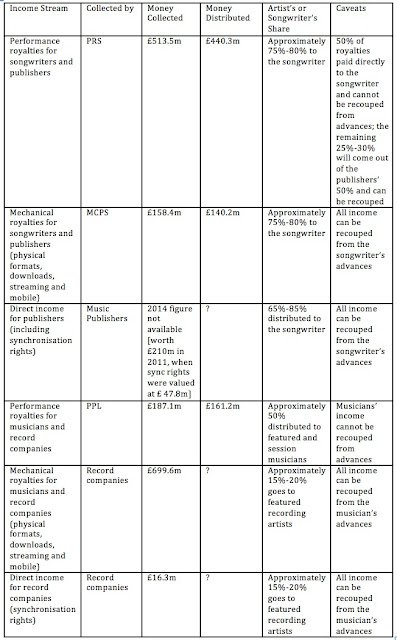
Following on from the previous two blog entries, which took a comparative look at UK collection societies and the income earned by live and recorded music, I’ve made a stab at presenting UK recording and publishing income for 2014.
           The statistics come from a variety of sources and it is risky to contrast them in this manner. In addition, I don’t have privileged access to information. What the figures should help indicate, however, is the relative health of each area. I’ve also made a stab at indicating what proportion of money will go to the songwriter or performing artist albeit that, unless the money is paid to them directly by a collection society, there are plenty of deductions and reductions that can be added to the percentages given in the final column. Significantly and spitefully, I have left out the money from live music, other than performance royalties that PRS collects for songwriters and publishers.


While the collection societies and the British record industries’ trade body BPI are reasonably good at indicating the money that has come into the UK, they are less forthcoming about the money that is leaving. The PRS, MCPS and PPL figures include income that is derived via reciprocal links with foreign collection societies, but they fail to state how much is going in the opposite direction. We don’t know how much money is going to foreign songwriters, publishers, record companies and musicians. Moreover, the record company figures also say nothing about the nationality of the musicians who will be receiving the royalties, nor do they mention the record companies’ countries of origin.
            According to Will Page, there was a time when publishers’ income was divided 40:40:20 between performing, mechanical and synchronisation streams. The figures above would indicate that the split is now divided something like 70:22:8. While this new division highlights the decline of record sales, it distorts the income that can be made from sync rights, which in overall terms has risen considerably in the past few years. In fact, the £47.8m figure given in relation to songwriting sync rights seems like a conservative reckoning, as does the £16.3m for sound recording sync rights. The latter figure comes from IFPI, but in 2011 BPI were regarding this income as nearer to £22m.
While the mechanical royalties for songwriters and publishers are certainly declining, these figures show them to be in better health than some PRS for Music information would have us believe. The PRS for Music Financial Review for 2014 lists recorded music as being worth £63.1m. The higher figure of £140.2m quoted here comes from MCPS’s own Report and Statements and includes the mechanical income that is derived from online licensing and broadcasting income.
            PRS and MCPS generally operate joint licences when it comes to online income (there are also a few minor income streams that are jointly licenced between PRS and PPL). There are no figures available to show how this income is split: PRS for Music instead publish a total figure of £79.7m. This figure is around 22% of the £363.8m that record companies derive from downloads (£249m) and streaming (£115m). The proportion of this money that makes its way to performing artists is much debated.
            But how much money in royalties is going to songwriters and artists overall?  A final, admittedly rough, outcome would reveal something like the following:
  • Performance royalties for songwriters: £374m (roughly two-thirds of which is non-recoupable)
  • Mechanical royalties for songwriters: £119m (recoupable)
  • Sync rights for songwriters: £33m (recoupable)
  • Performance royalties for musicians: £81m (non-recoupable)
  • Mechanical royalties for musicians: £122m (recoupable)
  • Sync rights for musicians: £3m (recoupable)
The money’s in the publishing; it is also in performance.

Monday, 2 March 2015

The Brit Awards 2015: The Big One


The big one, that’s what they called it. This was the term Ant & Dec, the presenters of this year’s Brit Awards, used for the British Album of the Year category. The whole show was structured so that it led up to this award, the final honour of the night. It has always been an important trophy. However, between 1977 and 2010 (and with a reprise in 2012) it was eclipsed by the Outstanding Contribution award, which in these years held the honour of being the concluding prize.
            Now the Brits prioritize the album. Why should the BPI, the institution behind the Awards, want them to have this focus? Surely they are rendering their ceremony out of date: albums are on the way out. Sales of physical albums in the UK declined last year from 61.4 million to 52.2 million. Sales of digital albums also went down. In 2013 32.6 million were sold; in 2014 this was down to 29.7 million. It is the streaming of individual tracks that is on the rise. Activity in this sphere doubled. There were 7.5 billion streams in 2013; there were nearly 15 billion last year. If the Brit Awards were to have a modern focus, they would be swimming in this stream. And yet this digital format isn’t even mentioned in their categories.
            The BPI has its reasons. Although sales figures are going down, it is still albums that make the most money. The combined sales of physical and digital albums brought in £713 million last year. In comparison, single sales brought in £163 million. For the first time, streaming income was larger than that of singles. However, the value stood at just £175 million, less than a quarter of the value of album sales. Moreover, hidden behind these top-line retail sales figures, there are a whole series of profit margins and royalty payments. These place the profitability of the album even further ahead. There has been plenty of discussion about artists’ poor royalty rates when it comes to streaming. Although record companies are better placed to gain income from this format, it is the CD album that is easily their most profitable medium.
            This is not the only reason for the BPI’s focus, however. This organisation looks after the interests of the British music industry. Albums are more parochial than singles. In 2014 the top 10 best selling albums in Britain were all by British artists. This is the first time that this has happened. The situation was different for streaming. The year’s top 10 streamed tracks came from a variety of sources: five from British acts, three from the US, one from Holland and one from Canada. The end of year singles top 10 was less localized still, with four tracks from British artists, one from a Dutch act and five from Americans. This is reflective of a longer historical pattern. For the past ten years the best selling album in Britain has been by an artist from the UK. In contrast, since 2009 only one British artist has had the best selling single in the country, and that was Adele with her unstoppable track ‘Someone Like You’ in 2011.
            Although the Brit Awards are supposed to be about merit, they are really about money. This has become more imperative as the fortunes of the British music industry have declined. Writing about last year’s awards, I focused on the way they predict and promote the following year’s blockbuster talent. The British Album of the Year award is all about the previous year’s blockbuster, however. More often than not, it is handed to the best selling album of the previous 12 months. This was the case with this year’s winner, X by Ed Sheeran. It was also true of Emile Sandé’s win in 2013 and Adele’s in 2012.

Thursday, 20 February 2014

The Brit Awards 2014: There's Got to be a Way to Blockbuster!


In theory, the Brit Awards are about the recent past. To qualify for an award, an album or single must have been released in the previous 12 months and an artist must have released a recording in that period. In practice, they are all about the future. One aim of the televised ceremony is to maximize album and single sales. The awards presentations are leavened with live performances, and it is the latter that are more effective at promoting releases (following Adele’s performance at the 2011 ceremony, sales of ‘Someone Like You’ increased by 785%). Another aim is to promote new artists. The British Phonographic Industry, which operates the awards, has orientated them in this direction. In 2008 they introduced a ‘critics’ choice’ award, whereby a panel of industry insiders designate a forthcoming star. More recently, they have dropped their ‘outstanding contribution’ award, which used to be given to industry veterans, and replaced it with a ‘global success’ award, which seems to be the exclusive preserve of One Direction.
In theory, the Brit Awards are fair and open. The official website claims ‘The Brit Awards operates a completely transparent procedure’. It details the qualifying criteria: all albums and the 1,000 best-selling singles released by British artists in the preceding sales period are eligible. Industry figures then put forward their personal top fives after being sent a list of these titles. In practice, the awards are closed and unclear. There is no information about who chooses the eventual winners or how they are chosen. There is also no explanation of why, despite the multitude of qualifying artists and records, such a small number make it through to the final shortlist. This year, nine separate awards were available for British artists, with winners chosen from 46 shortlist places. However, only 24 acts shared the nominations between them.
In theory, the aim of the Brit Awards is to celebrate British music. In practice, they are reliant on foreign talent. There are three ‘international’ awards, and in order to maximize viewing figures (and sell the latest tracks and concerts by the artists concerned) there are live performances by major global stars. This presents an awkward balancing act for the British Phonographic Industry. The nascent British acts that it is promoting – last night Disclosure, Bastille and Rudimental were among the artists to perform live – have to measure up against seasoned American performers – Beyoncé, Katy Perry and Bruno Mars all appeared, and the show was stolen by Pharrell Williams and Nile Rodgers.
The Brit Awards are evidence of a culture of blockbusters. In her recent book of the same name, Anita Elberse argues, ‘The highest-performing entertainment businesses take their chances on a small group of titles and turn those choices into successes by investing heavily in their development’. This is the opposite of Chris Anderson’s Long Tail theory; rather than the ‘future of business’ coming from ‘selling less of more’, the focus of media corporations is concentrated on a few stars and a few key releases. Time is concentrated, too. Aside from talent shows, there are now few opportunities to promote music on British television. The record companies have to focus much of their promotional activity on this single annual event.
As a result, the Brit Awards have to ensure that the critic’s choice is right. These are the future blockbuster acts who they hope will sit alongside the American stars. So far, they haven’t done badly. The first winner was Adele, who was the best selling albums artist in the world in 2011. The second was Florence and the Machine, whose two albums topped the UK charts. The third was Ellie Goulding, who has sold over 10 million singles worldwide. The fourth was Jessie J, whose first single ‘Price Tag’ debuted at number on in the UK singles chart. The fifth was Emeli Sandé, who had the UK’s biggest selling album of 2012. The sixth was Tom O’Dell, who perhaps has the lowest profile of the winners so far, but has still achieved a number one UK album.
2014’s critics’ choice is Sam Smith. He has already proved his worth via the music industry’s version of an apprentice scheme. He has been ‘featured’ on a number of singles by other acts. The first was ‘Latch’ by Disclosure, which reached the UK top 20 in late 2012. His next guest spot was on ‘La La La’ by Naughty Boy, which reached number one in Britain, Belgium, the Czech Republic, Italy and the Lebanon. Confirming the concentrated nature of the Brit Awards and the British music industry, Disclosure were nominated for four awards this year and ‘La La La’ was shortlisted for best single and best video.
Back in 1973, the British glam rock group Sweet released a single which asked ‘does anyone know the way, there’s got to be a way, to blockbuster?’ They found the answer. After the group appeared on Top of the Pops wearing make-up and German army uniforms their record went to number one. In 2014 there is a new response: get your act nominated for as many Brit Awards as possible. We’ll need to look at next week’s charts to find out who the real winners were.
N.B. An edited version of this article is available, with academic rigour and journalistic flair, at The Conversation.