Friday, 11 December 2015

Copyright is Odd

For a long time I’ve had an interest in the value accorded to lyrics and to lyricists. As part of my investigations, I have done some work on joint- and co-authorship rules. Different countries have different policies regarding the coming together of words and music in the form of a song. Some regard lyrics and composition as forming an act of joint authorship, while others consider them to be separate. The UK has changed from the latter to the former. In 2013 an amendment was made to the Copyright, Designs and Patents Act, recognising works of co-authorship.
            These decisions can matter. Co-authorship has meant that the term of copyright for lyrics or music has been lengthened for some songs. Joint authorship can safeguard a lyricist’s share of copyright when an instrumental or foreign language version is made of their song.
            On Wednesday I gave a talk about this subject at Birkbeck, contributing to a workshop on Copyright and Business Models in Music Publishing. It was a good event, attended by people from the industry alongside academics. One of my conclusions was that the UK’s new co-authorship rules have had little effect on the practices of contemporary songwriters, but that this is interesting in itself, as it is evidence of the fact that artists can find ways to circumvent copyright law. In summary, I stated that ‘music copyright is odd’. Stephanie Dales, who was representing the Intellectual Property Office at the event, picked up on this in her own talk. She said that she would alter one word, though. Her conclusion from working in the field of IP law is that all copyright is odd.
            You can access my paper here. 

Sunday, 29 November 2015

Keep Music Auto!

Music technology is divisive. On the one hand, there are the early adopters: the musicians who take up new developments to develop new sounds. On the other hand, there is the old guard: the traditionalists who regard technology as cheating. For them, new music machines don’t represent progress. They are instead a means by which ‘real’ musicians are deprived of honest work.
            The invention of sound recording was a major cause for complaint. In 1906, John Philip Sousa railed against ‘the menace of mechanical music’. He thought that if people had records they would no longer feel the need to make music of their own. Sousa fretted, ‘vocal exercises will be out of vogue! Then what of the national throat? Will it not weaken? What of the national chest? Will it not shrink?’ Musicians’ unions have campaigned along similar lines. The British MU and the American AFM have both fought to ‘keep music live’. They too have seen the ‘ever-present menace’ of recorded music, claiming that, if it becomes dominant, ‘the musician may well become extinct and music may cease to be written’.
            And now we have auto-tune. This device invites similar vitriol – just look at its name. It is telling us that it will automate voices and it will automatically write tunes. To use auto-tune is to cheat, replacing humans with machines. Some musicians are angry about it. Christine Aguilera has a t-shirt that says ‘auto-tune is for pussies’, Death Cab for Cutie have worn ribbons to mark their disgust at the use of the device, Jay-Z has recorded ‘D.O.A. (Death of Auto-Tune)’.
            Those who spring to auto-tune’s defence cite its use as a creative tool. It is part of a lineage of treated vocals. Artists as diverse as Kraftwerk, Neil Young, Cher and Kanye West have used machines to reach places beyond the human voice. Conversely, auto-tune and vocoders are viewed as having a particular humanity. They can highlight both the loneliness and the funkiness of the soul. Auto-tune is also credited with being a democratising instrument, one that enables non-singers to express their full emotional range.
            What is less regularly remarked upon is the ability of machines to improve musicianship. Looking back at the early years of the phonograph, for example, we can see that sound recording helped to develop rhythmic control. Early recording artists were distinguished by their strict sense of time, a skill fostered by the limits imposed upon their work. The maximum duration of cylinders and discs in the 1890s was roughly two minutes. Artists recorded directly onto master records; if any mistakes were made these would have to be scrapped and the piece started over, literally, from scratch. Consequently, the tempo and the timing of performances were worked out prior to recording. The early recording artist Billy Murray commented, ‘We are taught to keep perfect time. Stage performers are not held strictly to the limit as we are’.
Sound recording also helped to improve rhythmic fluency. The introduction of electric recording in the mid-1920s provided steps in this direction. There were now motorized record players with standardized speeds, a development that further heightened the awareness of being in time. Electric recording also enabled the rhythm section to be recorded properly: the microphone had the ability to capture both the bass and the drums. These developments could be seen as well as heard: the steady pulse of the rhythm was visible in a record’s grooves. It is in this period that we gained the verb ‘to groove’. Groups were becoming as tight and as rhythmic as a record’s spiral scratch.
            I think that something similar has happened with auto-tune. It hasn’t made singers lazy; it has stretched their abilities. Auto-tune may have its roots in the human voice, but the human voice is now mimicking this machine. It has provided an example of what it means to have perfect pitch, and it has inspired singers to have wide vocal ranges and to master complicated riffs. Auto-tune has also encouraged songwriters to compose songs that demand outstanding vocal performances. Of course plenty of ‘cheating’ still goes on. Vocals are digitally manipulated so that they are perfectly in time and in tune. However, a singer will not make it these days unless they are almost perfect on their own. There is a feedback loop too. These corrected vocal performances only heighten expectations; each new vocal generation ‘naturally’ adopts the quantized characteristics of the last. The gymnastic bar of singing is constantly being raised. We needn’t lose sheep about machines replacing musicianship. In fact, if there is a nightmare scenario, it resides in the reverse. It may well be musicianship that is out of control. The singing is taking over the songs. 

Monday, 23 November 2015

Prick Up Our Ears

‘We never hear anything where no men were involved’. This is the opinion of Claire Boucher, better known as Grimes. She’s right, too. There are plenty of all-girl groups, and many of these groups have made conscious attempts to produce female and feminist music. Wholesale girl power is restricted, however. There is always a man lurking at some point in the process. By way of illustration, Grimes points out that Emily Lazar is the only female mastering engineer working today, while there are no female mixers at all. As a consequence, she feels that Art Angels, her new, self-made album, provides something novel. It is a truly female recording. Grimes says, ‘The whole record was produced, engineered, written, performed by a woman, which is pretty rare. I don’t know if I ever heard a record like that, fully, with vocals on and stuff.’
Art Angels is a valiant enterprise. There is nevertheless still a male presence in this woman’s music. We need only follow Grimes’ logic further down the line. Most instruments have been designed and built by men, as have most professional recording studios and most software programmes. It is men, primarily, who have been responsible for the development and manufacture of recording formats.
This matters aesthetically as well as politically. Record listening is a complex process. This can be witnessed in the interviews that Justin Morey and Phillip McIntyre conducted with artists who used samples. They wanted to know what attracted them to particular recorded sounds. I have quoted some of the responses before:

“Sometimes we might sample a drum loop that’s amazing, you know it’s got a fantastic sound. For us it’s the atmosphere that it gives [to] something . . . so [we look] more for the sound and the feel that a sample would give you rather than the playing.”

“So we sort of chanced upon all this stuff that we weren’t really aware of because it wasn’t part of our generation really … We really liked the kind of woody warmth to that stuff, which was all obviously produced in lovely studios, and the sound you were getting off the vinyl . . . And hearing that in the context of the cleanliness of the analogue synths and drum machines and stuff like that, we just enjoyed that whole kind of warmth really, and just the way it added this kind of organic dirt.”

“The sonics, the groove … it is essential the sonics.”

“the circumstances that they recorded in were atmospherically different than the way modern records are recorded, and that’s part of the whole thing”

“A lot of the time, it is the sound”

When we listen to records there are many things that prick up our ears. The songwriting and musicianship are clearly important, but so is the sound of the instruments, the sound of the room, the sound of the recording format itself. There is something great about this. A record is not just made by a community of musicians; it is made by a series of communities, including the production team, the mixers, the manufacturers and the mediators. Popular music truly is popular: it is of the people. Grimes is right, however, to make us pause for thought. Sometimes it is good to narrow the focus; we need to have records that reflect particular constituencies. This remains easier for some communities than others, however. There probably are records that are male through and through, from the songwriter’s initial idea to the finalisation of the recording format. We are still waiting for a record where only women are involved.

Monday, 9 November 2015

It's Not a Game of Monopoly

In an earlier blog entry, I found myself arguing with Lord Macaulay’s famous 1841 speech about the extension of copyright and its impact on the free trade of ideas. Macaulay argued that: ‘Copyright is monopoly, and produces all the effects which the general voice of mankind attributes to monopoly. .... The effect of monopoly generally is to make articles scarce, to make them dear, and to make them bad’.
In contrast, I suggested that music collection societies, which operate as natural monopolies in most countries, produce the opposite effects. Through their blanket licences they help to make music accessible and they sometimes make it cheap. In fact, in their ability to facilitate the business-to-business trade in music, they provide the context in which the public is able to receive a great deal of its music for free. They also help us to access a variety of music, as most of their licensing schemes provide standard rates. Thus it costs users no more to play a Beyoncé record than it does for them to play one Bis.
In addition, I argued that it is those artists who manage to gain individual control over their copyrights who are most likely to commit the evil that Maccaulay describes. It has generally been established and successful performers, such as Taylor Swift, Prince or Thom Yorke, who have managed to escape blanket licensing, whether that is the licensing of a record company or the licensing of a collection society. There are, of course, many positives about the degree of control that they have been able to gain over their careers. This control has nevertheless enabled them to make their work scarce (it doesn’t appear on streaming services) and to sometimes made it dear (as those forced to purchase 1989 on CD will testify).
Collection societies have, in general, been transparent and fairly even-handed. Their licensing schemes are made public and they offer standard terms. There are some injustices, nonetheless. PRS, for example, has had policies that divert income from popular music towards classical repertoire. MCPS, meanwhile, operates licensing schemes that become cheaper the higher up you go. Smaller record companies have to pay licences on the basis of the number of records of manufactured, while larger companies pay on the basis of the number of copies sold. The former have to pay their bills upfront; the latter are invoiced at a later date. Larger companies also pay lower commission rates and benefit from further economies of scale if they use MCPS to licence throughout Europe.
These various concessions don’t compare, however, to the secrecy and inconsistency that surrounds streaming deals. While some artists are escaping monopolies in order not to appear on streaming platforms, record companies and publishers are escaping monopolies in order to deal directly with the same sites. As I have previously documented, record companies maintain that streaming falls under the ‘making available’ right and they believe it is analogous to the sale of sound recordings rather than the broadcast of digital radio. As a consequence they have been able to escape the monopolistic licensing that public performance would entail. They have conducted their own deals with streaming companies and they have avoided the 50% royalty that PPL accords to performing artists.
In some ways, this isn’t a great break with tradition. Record companies have always made most of their deals directly. The same is not true of the publishing companies: the majority of their mechanical and performance licensing has taken place via the monopolistic rates and regulations of the collection societies. By making direct deals with the streaming companies they are entering unchartered waters. And this is precisely what attracts them: they want to escape those collective rules. It’s a complicated business nonetheless. Although record companies have convinced themselves that streaming is largely ‘mechanical’ in nature, the publishing world regards it as being equally divided between the performing and mechanical rights. However, while it is relatively easy for publishing companies to withdraw from MCPS and to self-administer the mechanical right for streaming purposes, they have no such jurisdiction over the performing right. Songwriters assign this right to their collection societies, rather than to their publishers. Consequently, in this area it is the collection societies who have control.
In Europe, the publishers’ solution to this problem has been to form ‘Special Purpose Vehicles’ with the collection societies. These SPVs entitle the publishers to deal directly with streaming companies and secure terms that cover both the performing and mechanical rights. Any terms reached must be agreed by the collection societies, however. Once the royalties have been calculated the income will make its way to artists either via their collection societies (the performing right share, presumably) or directly from their publishers (if this aspect of the mechanical right is escaping the collection societies it will mark another another area of income that is less readily identifiable as recorded music).
The publishers argue that licensing directly enables them to negotiate higher royalties for their artists, as they escape the flat demands of the collection societies. They also argue that this method is more efficient for the streaming companies, as these deals can be completed more quickly and can expand beyond the home country remit of the collection societies. Songwriters are less comfortable. According to the Music Managers Forum many of them would prefer for streaming income to fall under the remit of the collection societies:
possibly because they trust their CMO [collection society] more than their label or publisher; or because payments via CMOs often circumvent contractual terms that enable labels or publishers to retain income; or because they feel collective licensing is fairer to all, because everyone earns the same per play fees, rather than bigger artists or rights owners having a better deal.
Nevertheless, if they are signed with a major publisher, they will find that they have no choice. Sony/ATV has entered into an SPV with PRS and GEMA, Universal has one with SACEM, Warner/Chappel has SPVs with a number of collection societies including PRS, while BMG has a joint venture with GEMA. Meanwhile, Kobalt, who are probably the most innovative publishing company operating today, have actually bought the collection society, AMRA, which they employ to conduct their SPVs.
            And what does this mean for the consumer? In the first instance, it might make some music scarce. Although these direct deals are of potential benefit to the streaming companies because they can licence one publisher for multiple territories, the drawback is that they have to do deals with each publisher individually. Some catalogues may well be left out. These joint ventures might also make music dear. If publishers are able to negotiate higher royalties for their songwriters, then the consumer may well end up paying for them. This could be directly, via subscription charges, or indirectly, via the advertising fees that result from fremium services. In addition, some music might end up being dearer than others, which in turn might make it scarce. The withdrawal from monopoly tumbles on and on . . .  

Friday, 30 October 2015

Assets and Equity

Assets. They have long complicated music industry economics. Record companies have argued that they deserve to own the majority of sound recording copyrights because a minority of artists succeed. They need to keep the copyrights of the 10% of artists who recoup their advances in order to pay off the losses of the 90% who are in debt. While the losses from ‘unsuccessful’ artists are detailed in record company balance sheets, the value of their copyright catalogues does not appear there. Nevertheless, as the Music Managers’ Forum has argued, ‘the copyright catalogues of the record companies are their most valuable asset’. Traditionally, the biggest deals that have been made in the business have arisen when these catalogues have been sold on to other companies. These transactions have happened when the major companies have merged with one another and when larger companies have bought up indie labels. Derek Green, head of China Records, made the economics of the indie sector clear:
Well, the only reason we do it is because on our balance sheets we have the value of our masters and the value of our contracts marked as zero. Therefore technically every year our accountants tell us we’re bankrupt. But what we really know and believe is that the majors will pay millions to buy us.
The crucial factor about these takeovers is that the money went to the owners of the record companies that were being sold. Unless artists happened to have equity in the company, they would gain little, nothing or perhaps even lose out from the sale. There are many stories of artists who found themselves marginalised when transferred to a new corporation.
            The sale of one record company to another did at least have a degree of honesty and transparency about it. The owner of the record company that was being sold would be profiting from an institution that he or she had overseen. The assets up for sale were the recordings that they had invested in, even if some of those recordings had been fully subsidised by artists who had recouped.
Streaming provides continuities and discrepancies with this model. We still have the situation whereby companies are making little profit – even Spotify is running at a loss. The low sums of money being generated by these companies is presenting a problem for record labels, whose income from streaming is, in the first instance, based on a share of advertising and subscription revenues. The record companies’ songs might be being streamed billions of times, but this doesn’t mean that advertisers are willing to invest in these new advertising platforms or that consumers are willing to upgrade to subscription services. Last year in the UK there were 14.8 billion individual audio streams and 14.3 billion video streams. Despite this vast traffic, the money generated by subscription services only constituted 12.4% of the total income for recorded music, while the money from ad-supported services - although it was the avenue for the vast majority of those 29 billion streams - only constituted 3.5% of the same market. In total, the income from streaming contributed £115m to the UK’s recording ‘sales’ last year. Vinyl albums and CDs, meanwhile, contributed £320m. Record companies are nevertheless continuing to have faith in streaming services. If the income generated by these services hasn’t managed to offset the decline in physical and download sales, streaming is having the effect of converting ‘pirate’ users of musical content into legal consumers.
What is more significant for our immediate purposes is that record companies have found diverse ways to generate income from streams. Their share of advertising and subscription revenue is backed up by minimum guarantees. Each record company who enters into a licensing agreement with a streaming company will be guaranteed a minimum sum each time one of their tracks is played. In addition, some record companies receive a guaranteed sum for each subscriber who signs up to the streaming company. These minimums only come into force if the revenue target is not reached. In the instances where this income did come into play last year, it will have been reported as part of the total streaming income of £115m.
There are, however, areas of streaming income that are not reported on the record industry’s balance sheets. Most importantly, record companies demand equity in streaming companies as part of their licensing agreements. Here, as the MMF have identified, there is an echo of the ‘bankrupt’ nature of indie record companies. Just as those old indie companies were aware that their impoverished balance sheets disguised the fact they could be worth millions if sold on to larger record companies, today’s record labels are aware that, when it comes to streaming, the ‘single biggest revenue generator may be the sale of the streaming business, either to an existing major tech or media firm or through flotation on a stock exchange’. What is more, the record labels might even ‘agree to less favourable terms on revenue share and minimum guarantees, where income is shared with the artists, in return for a better deal on equity’.  And who will get the money from the sale of the sale of the streaming companies? The MMF have reported that:
The assumption is that many labels will keep these profits in their entirety, citing clauses in artist contracts that say the record company is only obliged to pay royalties to artists on income directly and identifiably attributable to a specific recording.
Here there is a difference to earlier practice. The record companies will be profiting from the sale of companies that they haven’t even had a hand in creating. The labels might argue that they have provided the essential content that has transformed streaming companies into valuable commodities, but that content is sound recordings, which have been created and in some cases paid for by recording artists. The record companies will not even be selling this content on to the new purchaser of the streaming company: the purchasing corporation will still have to licence the recordings. No wonder then that it is artists, rather than record companies, who are raising questions about the land of streams. 

Wednesday, 21 October 2015

I’ve Been Making Available All My Life

In recent blog entries I have been taking a look at the recording and publishing industries, as well as at mechanical and performing rights. Mechanical rights, which are also known as reproduction rights, incorporate the right to copy a work and the right to issue copies of a work to the public. Performing rights encompass the right to perform to work in public and the right to communicate the work to the public, which includes broadcasting.
In ‘Adding Up the Publishing and Recording Industries 2014’ I stressed the monetary importance of performing right for both songwriters and recording artists. Under PRS for Music rules, songwriters are automatically entitled to 50% of income whenever their song is licensed for performance, whether this be in a live setting or via a broadcast. Similarly, under the ‘equitable remuneration’ rules operated by PPL, recording artists are entitled to 50% of income whenever their recordings are played in public premises or are broadcast on radio or TV. In both cases these royalties are safeguarded: they cannot be recouped from advances.
In ‘Broadcast Y’Self Fitter’ I stressed the difference between classifying digital income as a performance or a mechanical right. If it is regarded as the former, being considered more akin to broadcasting, then artists as well as songwriters can be entitled to as much as 50% of the royalties. If it is regarded as the latter, being instead associated with physical recordings, the recording artist’s royalty rate can drop to something like 15%.
            I’m not alone in having this interest. Since uploading my last blog entry, the Music Managers Forum has published Dissecting the Digital Dollar: How Streaming Services are Licensed and the Challenges Artists Now Face. It is an important document, providing a detailed and lucid account of copyright and royalties in the digital age. It also provides further detail for the case that I have been making.
            One of the best ways to highlight injustices and inconsistencies in respect of royalties is to compare the activities of the collection societies, publishers and record labels. Publishers’ collection societies view the broadcasting of songs as involving both a mechanical and a performance right. In Britain, both the Performing Right Society (PRS) and the Mechanical-Copyright Protection Society (MCPS) have collected income for radio broadcasts. The performing and mechanical rights are present for online licensing as well, whether this is for online radio, downloads or streams. Consequently, the umbrella society, PRS for Music, operates joint licences to capture both of these forms of copyright.
There are differences in the way that income is divided, however. Perhaps understandably, as the format has an affinity with the sales of records in record shops, downloads are regarded as being more mechanical: 75% of royalties collected under the relevant joint licensing scheme go to MCPS and 25% to PRS. Online radio witnesses the reverse: 75% of income goes to PRS and 25% to MCPS. Again, this is understandable, as radio leans more towards the communication right that is enshrined in PRS activity, than it does towards the right to copy, which is patrolled by MCPS. Streaming sits in between: here the money from joint licensing is divided 50/50 between MCPS and PRS. These splits have implications for songwriters. They might receive similar overall shares in each area: for example, both the mechanical and performance income could be divided 75/25 between artists and publishers. As stated above, however, it is only the performance income that is safeguarded against advances: 50% goes directly to the songwriter and cannot be recouped.
If the recording world were to have parity with music publishing, streaming would be regarded as having an equal split between mechanical and performing rights. It would then follow that record companies would collect the 50% of the streaming royalty that relates to the mechanical right themselves. From this income, they would pay their recording artists a similar royalty to their income for physical sales: this would result in a new recording artist receiving an approximate 15% share. The recording artist should do better when it comes to the performing right. 50% of streaming income would be collected by the relevant performing right society, which in the UK is Phonographic Performance Ltd (PPL). This income would itself then be split 50/50, with half going to the record company and half to the recording artist.
But this doesn’t happen. Record companies collect the whole of the streaming income. According to PPL’s own literature, the labels regard both downloading and streaming as involving the mechanical right only. Their 2011 Annual Report states:
PPL’s online revenues remain limited as the majority of online sound recording licensing is carried out directly by rights owners. This reflects the prevailing view of record companies that downloading and on-demand streaming is analogous to the distribution of sound recordings, a traditional record company function.
Running somewhat counter to this argument, the record companies’ also claim that recording artists are not entitled to ‘equitable remuneration’ when it comes to downloading and streaming because this is an area in which performing rights operate differently.
            Here they refer to the ‘making available’ right, which was formulated during World Intellectual Property Organisation treaties of 1996 and enshrined in EU law in 2001. Dissecting the Digital Dollar outlines the origins of this right:
the communication control, where defined in copyright law, traditionally related to conventional broadcasting which, while easily extended to webcasting, might not apply to other kinds of digital transmission. To ensure digital communication of this kind would still be restricted by copyright, and perhaps to distinguish it from the existing controls that covered broadcasting, some rights owners lobbied to have a separate control added to copyright law called ‘making available’.
The activity controlled by this law is ‘electronic transmission in such a way that members of the public may access the recording from a place and at a time individually chosen by them’. As such, it clearly encompasses downloading, but does not encompass online radio (as a result online income in this area is collected by PPL). The record companies believe that the ‘making available’ right encompasses streaming as well. However, as the MMF report states, ‘not all artists agree’ with this point of view. As illustrated by the way that the publishing sector deals with streaming income, this activity can be regarded as akin to both broadcasting and to record sales.
            Why does any of this matter? ‘Making available’ is the only area of sound recording performance rights that is exempt from ‘equitable remuneration’. Consequently, artists are not guaranteed 50% of this income. Instead, it can be collected by record companies directly and some artists will therefore be on a standard royalty rate as low as 15%. What is more, any royalties collected can be recouped from advances.
            Dissecting the Digital Dollar includes a survey conducted with artist managers. Their responses to two questions are particularly telling. 78% of respondents believed that equitable remuneration should exist for all digital services, including both downloads and streams. However, when asked if they know how collection societies proportion streaming income according to the mechanical right and the performing right, only 3% replied in the affirmative.  

Monday, 5 October 2015

Adding up the Publishing and Recording Industries 2014

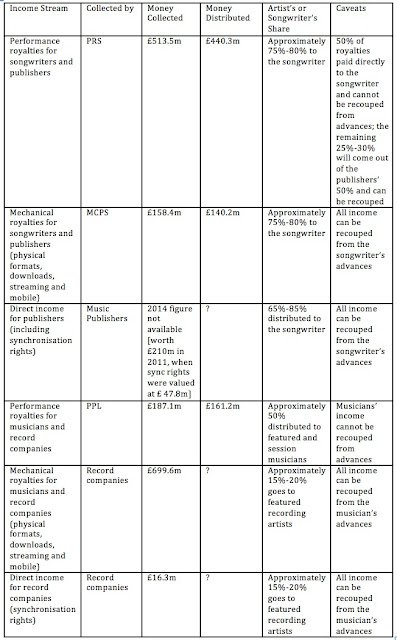
Following on from the previous two blog entries, which took a comparative look at UK collection societies and the income earned by live and recorded music, I’ve made a stab at presenting UK recording and publishing income for 2014.
           The statistics come from a variety of sources and it is risky to contrast them in this manner. In addition, I don’t have privileged access to information. What the figures should help indicate, however, is the relative health of each area. I’ve also made a stab at indicating what proportion of money will go to the songwriter or performing artist albeit that, unless the money is paid to them directly by a collection society, there are plenty of deductions and reductions that can be added to the percentages given in the final column. Significantly and spitefully, I have left out the money from live music, other than performance royalties that PRS collects for songwriters and publishers.


While the collection societies and the British record industries’ trade body BPI are reasonably good at indicating the money that has come into the UK, they are less forthcoming about the money that is leaving. The PRS, MCPS and PPL figures include income that is derived via reciprocal links with foreign collection societies, but they fail to state how much is going in the opposite direction. We don’t know how much money is going to foreign songwriters, publishers, record companies and musicians. Moreover, the record company figures also say nothing about the nationality of the musicians who will be receiving the royalties, nor do they mention the record companies’ countries of origin.
            According to Will Page, there was a time when publishers’ income was divided 40:40:20 between performing, mechanical and synchronisation streams. The figures above would indicate that the split is now divided something like 70:22:8. While this new division highlights the decline of record sales, it distorts the income that can be made from sync rights, which in overall terms has risen considerably in the past few years. In fact, the £47.8m figure given in relation to songwriting sync rights seems like a conservative reckoning, as does the £16.3m for sound recording sync rights. The latter figure comes from IFPI, but in 2011 BPI were regarding this income as nearer to £22m.
While the mechanical royalties for songwriters and publishers are certainly declining, these figures show them to be in better health than some PRS for Music information would have us believe. The PRS for Music Financial Review for 2014 lists recorded music as being worth £63.1m. The higher figure of £140.2m quoted here comes from MCPS’s own Report and Statements and includes the mechanical income that is derived from online licensing and broadcasting income.
            PRS and MCPS generally operate joint licences when it comes to online income (there are also a few minor income streams that are jointly licenced between PRS and PPL). There are no figures available to show how this income is split: PRS for Music instead publish a total figure of £79.7m. This figure is around 22% of the £363.8m that record companies derive from downloads (£249m) and streaming (£115m). The proportion of this money that makes its way to performing artists is much debated.
            But how much money in royalties is going to songwriters and artists overall?  A final, admittedly rough, outcome would reveal something like the following:
  • Performance royalties for songwriters: £374m (roughly two-thirds of which is non-recoupable)
  • Mechanical royalties for songwriters: £119m (recoupable)
  • Sync rights for songwriters: £33m (recoupable)
  • Performance royalties for musicians: £81m (non-recoupable)
  • Mechanical royalties for musicians: £122m (recoupable)
  • Sync rights for musicians: £3m (recoupable)
The money’s in the publishing; it is also in performance.