Showing posts with label IFPI. Show all posts

Friday, 23 December 2016

It's a Merry Christmas for Songwriters

Songwriters are earning four times as much as recording artists.
            We can reach this conclusion by using the work of Will Page, who is the go-to person for music industries’ statistics. When he worked for PRS for Music he would annually total up the British figures. Now that he is Spotify’s Director of Economics he is performing the same task on a global scale. He has discovered that our planetary music copyright business was worth $24.37bn in 2015. This represents a rise of $941m on 2014.
            In his findings, Page lists the money earned by the record company members of the International Federation of the Phonographic Industry (IFPI); the income of the publisher and composer members of the International Confederation of Societies of Authors and Composers (CISAC); and the money that is going to the publishers directly. The results are as follows:

IFPI digital recordings                           $6.5bn
IFPI physical recordings                        $5.0bn
IFPI performing rights                            $2.1bn
IFPI sync rights                                          $0.3bn
CISAC performing rights                          $6.8bn
CISAC mechanical rights                           $1.2bn
CISAC private copying income                 $0.2bn
Publishing sync rights                                 $0.8bn
Publishing other                                            $0.8bn
Non-CISAC publishing mechanicals          $0.5bn

It is size of the collections and the increase in the money that has attracted headlines. Nevertheless, Page is also keen to point out that there is ‘a misconception about the David-Goliath relationship between labels and publishing’. The publishers are not dwarfed. The overall income for songwriting copyrights is $10.4bn (42.7% of the total), while the income for sound recording copyrights is $14bn (57.3% of the total). According to Page:
When you factored in all the monies that flow to PROs [Performing Rights Organisations], publishers and songwriters, they were much more neck-and-neck in true value than often perceived. However, how that money then flows from firms (labels, publishers and collectives) to individuals (artists and songwriters) is an entirely different conversation.
Page does not enter into this dialogue and it is easy to understand why. It is hard enough getting the total income figures from industry organisations, but at least this information is available. In contrast, the contract details of songwriters and recording artists remain private. As such, it is difficult to determine the percentage royalties that they are receiving from their publishers and record labels. Moreover, these royalties vary from country to country and from artist to artist. These royalties have also varied through time. Songwriters and performers who signed contracts in the 1950s or 1960s, for example, will generally be on lower royalty rates than artists who are signing contracts today.
But the conversation is still worth having. It provides a means of assessing the relative prosperity of songwriters and recording artists. And while the precise details of contracts are not known, some general figures are available. If all artists were on contemporary UK contracts, the splits would look something like this:

Sound Recoding Copyright $14bn
IFPI digital recordings            80%-85% record labels/15%-20% recording artists
IFPI physical recordings         80%-85% record labels/15%-20% recording artists
IFPI performing rights             50% record labels/50% recording artists
IFPI sync rights                        50%-85% record labels/15%-50% recording artists

Songwriting Copyright $10.4bn
CISAC performing rights                           20%-25% publishers/75%-80% songwriters
CISAC mechanical rights                           20%-25% publishers/75%-80% songwriters
CISAC private copying income                  50% publishers/50% songwriters?
Publishing sync rights                                  15%-35% publishers/65%-85% songwriters
Publishing other                                            15%-35% publishers/65%-85% songwriters?
Non-CISAC publishing mechanicals            20%-25% publishers/75%-80% songwriters?

Although some of these splits can only be estimated, these percentages would place the income of songwriters far above that of recording artists. Their take home would be something like $7.75bn, while the overall copyright income for recording artists would only be $2.1bn.
Songwriters would also be in a better position than recording artists when it comes to non-recoupable royalties, the money that cannot be used to pay off advances. At least £3.4bn of the songwriting income would be free from recoupment. In contrast, the only element that would be non-recoupable for recording artists would be the $1.05bn earned from their 50% share of the IFPI performing rights.
            These total figures would have to be reduced, however. At least half of the worldwide copyright income is derived from back catalogue. Consequently, there will be many recording artists and songwriters who are on less favourable percentages than presented here. However, even though the totals for songwriting and recording would come down, there would be an even greater bias in favor of the writers. Old recording contracts tend to be more punitive than old publishing contracts are. The percentages for the artists are proportionally lower and the terms of the contracts last longer. Moreover, songwriters have been guaranteed at least 50% of the performing rights income in most territories for over a century. This is the biggest single income stream and it is non-recoupable. In contrast, recording artists in many countries are still not guaranteed equitable remuneration for performing rights income. Although this 50% share is now mandatory throughout the European Union, this has only been the case since the Rental and Lending Rights Directive of 1992.
            The money is still in the publishing.

Monday, 5 October 2015

Adding up the Publishing and Recording Industries 2014

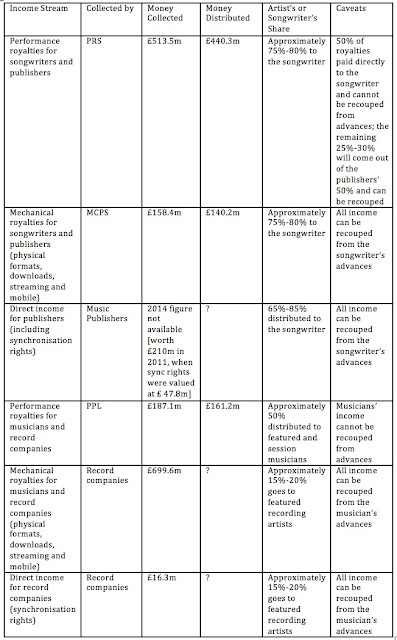
Following on from the previous two blog entries, which took a comparative look at UK collection societies and the income earned by live and recorded music, I’ve made a stab at presenting UK recording and publishing income for 2014.
           The statistics come from a variety of sources and it is risky to contrast them in this manner. In addition, I don’t have privileged access to information. What the figures should help indicate, however, is the relative health of each area. I’ve also made a stab at indicating what proportion of money will go to the songwriter or performing artist albeit that, unless the money is paid to them directly by a collection society, there are plenty of deductions and reductions that can be added to the percentages given in the final column. Significantly and spitefully, I have left out the money from live music, other than performance royalties that PRS collects for songwriters and publishers.


While the collection societies and the British record industries’ trade body BPI are reasonably good at indicating the money that has come into the UK, they are less forthcoming about the money that is leaving. The PRS, MCPS and PPL figures include income that is derived via reciprocal links with foreign collection societies, but they fail to state how much is going in the opposite direction. We don’t know how much money is going to foreign songwriters, publishers, record companies and musicians. Moreover, the record company figures also say nothing about the nationality of the musicians who will be receiving the royalties, nor do they mention the record companies’ countries of origin.
            According to Will Page, there was a time when publishers’ income was divided 40:40:20 between performing, mechanical and synchronisation streams. The figures above would indicate that the split is now divided something like 70:22:8. While this new division highlights the decline of record sales, it distorts the income that can be made from sync rights, which in overall terms has risen considerably in the past few years. In fact, the £47.8m figure given in relation to songwriting sync rights seems like a conservative reckoning, as does the £16.3m for sound recording sync rights. The latter figure comes from IFPI, but in 2011 BPI were regarding this income as nearer to £22m.
While the mechanical royalties for songwriters and publishers are certainly declining, these figures show them to be in better health than some PRS for Music information would have us believe. The PRS for Music Financial Review for 2014 lists recorded music as being worth £63.1m. The higher figure of £140.2m quoted here comes from MCPS’s own Report and Statements and includes the mechanical income that is derived from online licensing and broadcasting income.
            PRS and MCPS generally operate joint licences when it comes to online income (there are also a few minor income streams that are jointly licenced between PRS and PPL). There are no figures available to show how this income is split: PRS for Music instead publish a total figure of £79.7m. This figure is around 22% of the £363.8m that record companies derive from downloads (£249m) and streaming (£115m). The proportion of this money that makes its way to performing artists is much debated.
            But how much money in royalties is going to songwriters and artists overall?  A final, admittedly rough, outcome would reveal something like the following:
  • Performance royalties for songwriters: £374m (roughly two-thirds of which is non-recoupable)
  • Mechanical royalties for songwriters: £119m (recoupable)
  • Sync rights for songwriters: £33m (recoupable)
  • Performance royalties for musicians: £81m (non-recoupable)
  • Mechanical royalties for musicians: £122m (recoupable)
  • Sync rights for musicians: £3m (recoupable)
The money’s in the publishing; it is also in performance.

Tuesday, 9 June 2015

The Collaborators


I have written an article titled, ‘A Great Friggin’ Swindle? Sex Pistols, School Kids and 1979’, which is due to appear in Popular Music and Society towards the end of this year. 1979 was the year of the Sex Pistols’ greatest chart success. They had their biggest selling single in the UK (‘Something Else’ / ‘Friggin’ in the Riggin’) as well as three top 40 albums. It was also the year of their demise. Johnny Rotten had left in 1978, but effected the end of the group by taking his old manager, Malcolm McLaren, to court in February 1979. This was also the month in which Sid Vicious died.
            Rotten and McLaren fell out badly. In the song ‘Low Life’, Rotten refers to McLaren as an ‘egomaniac traitor’. In the film The Great Rock ‘n’ Roll Swindle, McLaren calls Rotten a ‘collaborator’. In his view, Rotten had stopped fighting the record industry and had become part of the system. He was being courted by Richard Branson of Virgin Records and was accepting his advances.
            In 1979 ‘collaborator’ could only have been taken as a term of abuse. Although punk sneered at hippie values (‘we mean it, man’), it too retained a distrust of ‘the man’, particularly when he was working for a record company. In the song ‘EMI’ Rotten claims an authenticity straight from the rock textbook. He boasts that the Sex Pistols are ‘for real’ and denigrates the record company for thinking the band were just ‘faking’ or ‘money making’. He later wrote, ‘big business is very wise/I’m crossing over into enterprise’, a lyric that should not be taken at face value: Rotten critiqued the idea of ‘careering’.
            Fast-forward to today and everyone is collaborating. Hits Songs Deconstructed have published an e-book that provides a statistical analysis of the songs that reached the top 10 in America last year. Their conclusion is that ‘Above all, 2014 was about collaboration’. 59 songs made the top ten, but out of these only 12% were written by solo writers. The rest were written be teams: 20% by two writers; 19% by three writers; 8% by four writers; 5% by five writers; 10% by six writers; 5% by seven writers; and 7% by ten or more writers. What’s more, these teams work in different combinations. Max Martin, who had a composing hand in eight top 10 hits (including four number ones), worked on different songs with Dr Luke (who had four top ten hits as a writer, two of which were written with Martin, two with other composers), Cirkut (four top ten hits; two with Martin, two without), Savan Kotecha (four top ten hits, all composed with Martin), Katy Perry (three top ten hits; two with Martin, one without), Shellback (three top ten hits; two with Martin, one without), Iggy Azalea (three top ten hits; one with Martin, two without), Taylor Swift (two top ten hits, both with Martin), Sarah Hudson (two top ten hits; one with Martin, one without), and Nicki Minaj (two top ten hits; one with Martin, one without). Writers such as Ed Sheeran, Benny Blanco, Jimmy Napes and Sam Smith – each of whom had three top ten hits – cast their own collaborative nets.
            It’s tempting to say that we are discussing different sorts of collaboration here: McLaren and Rotten were talking about collaborating with the record industry, while these modern songwriters are collaborating with each other. The writers are nevertheless supporting the industry’s aims. As I have written elsewhere, collaboration gives the record companies power. It can best be organised by them – they are the matchmakers and they are the gatekeepers - or at least that’s what they claim. IFPI, the trade body that represents ‘the recording industry worldwide’, produced another of its promotional Investing in Music reports in 2014. These documents make the case for the continuing importance of record companies, stressing that artists need their support if they want to make it big. Record companies offer finance and they offer ‘a network of connections’. They can introduce you to the ‘best producers, sound engineers and session musicians in the business’; they can alert ‘other players in the industry, from songwriters to record producers’ that you have made the grade. You need to collaborate with them if you want to collaborate with others.

Monday, 2 December 2013

There's No Success Like Failure


Some adolescents go through a quotations phase. They want to show off their wisdom by memorising a few neat aphorisms. I was one of those kids and I supported my interest by buying a small book of quotations. This had pages of quotes from Shakespeare and the bible, and a good dozen or so from Oscar Wilde. There was only one, however, from a popular musician. This was Bob Dylan’s lyric from ‘Love Minus Zero, No Limit’, in which he claimed that ‘there’s no success like failure’.
            I know that it’s become a clichéd term, but it’s pertinent to popular music because it is the code by which it lives. The whole economic structure of the record industry is premised on failure. In fact, it ignores Dylan’s rejoinder that ‘failure’s no success at all’. The main reason why record companies have power and income is because they own sound recording copyrights, and they only own these copyrights because they are bad at their job. Hardly any of their acts succeed: it has been argued that as many as 95% fail to achieve profitability. This failure rate helps to keep the struggling artists in hock and the successful ones in check.
The ownership of sound recording copyright is perhaps the most dubious of all record company practices. Copyright is usually awarded to the ‘creator’ of a work. When it comes to songwriting copyright this is fairly straightforward: the creators are the writers, therefore copyright is automatically awarded to them. Sound recording copyright is different. In the UK, according to the 1988 Copyright Designs and Patents Act, the creator of a sound recording is the party ‘who made the arrangements for the recording to be made’. In practice, this is usually translated as being the party who paid for the recording. But record companies don’t pay for recordings, artists do. Or at least they attempt to. The costs of production are advanced to artists and are then ‘recouped’ from their royalties.
It is only when artists have made a clear profit against both their personal and recording advances that they start to see income from their record sales. IFPI’s recent Investing in Music report suggests that the recording costs for a ‘significant project’ can vary between $200,000 and $300,000. If we estimate that the average dealer price of an album is $8 and that an artist's royalty is 18% of this amount, this would mean that an they would have to sell between 139,000 and 208,000 copies in order to clear their recording advances alone. Some artists can achieve this and thus could argue that they have paid for their recordings. And yet even if they do so, it is almost unheard of for them to be awarded the sound recording copyright.
The artists who don’t reach the break-even point, for either their personal or recording advances, don’t have to pay back the deficit on their accounts. However, rather than this being an act of generosity on the part of the record companies, it is a situation from which they profit. It is on the basis of these failures that they justify their ownership of the copyrights of the artists who succeed. Moreover, artists are caught in a vicious circle. It has been argued that one of the main reasons why they have to ask for large advances is because they don't make any money out of sound recording copyright, but the reason why they don't make any money out of sound recording copyright is because they can't pay off their large advances. Record companies claim that as many as 95% of all artists fail to achieve profitability. And it is on this overall failure rate that they justify their ownership of all sound recording copyrights. Ann Harrison has quoted the record companies’ claim that, ‘If they had to return the copyrights of successful artists, they say they wouldn’t be able to invest as much in new artists in the future and that the culture of the nation would suffer as a result’. Once again, this presents them in a potentially generous light. It needs to be remembered, however, that it is the record companies who are responsible for such a high rate of failure: they crowd the market with music knowing that most of it will not succeed. And their 95% failure rate adds up: it becomes part of the expense of launching a new act. Failure contributes to the punitive nature of recording contracts and to the inflation of sales targets. These targets are set so high that few artists can achieve them; thus they live in fear that they will be the next ones to be dropped.
One of the other quotes in my little book was ‘knowledge is power’, a term that has been loosely attributed to Francis Bacon. In the past, the major labels claimed that it was impossible to have knowledge about what would sell and that this is what led to them spread their bets. Whether this is true or not, they have used their inabilities wisely. It has long been an industry in which failure is power.