Showing posts with label Mechanical Right. Show all posts

Monday, 9 November 2015

It's Not a Game of Monopoly

In an earlier blog entry, I found myself arguing with Lord Macaulay’s famous 1841 speech about the extension of copyright and its impact on the free trade of ideas. Macaulay argued that: ‘Copyright is monopoly, and produces all the effects which the general voice of mankind attributes to monopoly. .... The effect of monopoly generally is to make articles scarce, to make them dear, and to make them bad’.
In contrast, I suggested that music collection societies, which operate as natural monopolies in most countries, produce the opposite effects. Through their blanket licences they help to make music accessible and they sometimes make it cheap. In fact, in their ability to facilitate the business-to-business trade in music, they provide the context in which the public is able to receive a great deal of its music for free. They also help us to access a variety of music, as most of their licensing schemes provide standard rates. Thus it costs users no more to play a Beyoncé record than it does for them to play one Bis.
In addition, I argued that it is those artists who manage to gain individual control over their copyrights who are most likely to commit the evil that Maccaulay describes. It has generally been established and successful performers, such as Taylor Swift, Prince or Thom Yorke, who have managed to escape blanket licensing, whether that is the licensing of a record company or the licensing of a collection society. There are, of course, many positives about the degree of control that they have been able to gain over their careers. This control has nevertheless enabled them to make their work scarce (it doesn’t appear on streaming services) and to sometimes made it dear (as those forced to purchase 1989 on CD will testify).
Collection societies have, in general, been transparent and fairly even-handed. Their licensing schemes are made public and they offer standard terms. There are some injustices, nonetheless. PRS, for example, has had policies that divert income from popular music towards classical repertoire. MCPS, meanwhile, operates licensing schemes that become cheaper the higher up you go. Smaller record companies have to pay licences on the basis of the number of records of manufactured, while larger companies pay on the basis of the number of copies sold. The former have to pay their bills upfront; the latter are invoiced at a later date. Larger companies also pay lower commission rates and benefit from further economies of scale if they use MCPS to licence throughout Europe.
These various concessions don’t compare, however, to the secrecy and inconsistency that surrounds streaming deals. While some artists are escaping monopolies in order not to appear on streaming platforms, record companies and publishers are escaping monopolies in order to deal directly with the same sites. As I have previously documented, record companies maintain that streaming falls under the ‘making available’ right and they believe it is analogous to the sale of sound recordings rather than the broadcast of digital radio. As a consequence they have been able to escape the monopolistic licensing that public performance would entail. They have conducted their own deals with streaming companies and they have avoided the 50% royalty that PPL accords to performing artists.
In some ways, this isn’t a great break with tradition. Record companies have always made most of their deals directly. The same is not true of the publishing companies: the majority of their mechanical and performance licensing has taken place via the monopolistic rates and regulations of the collection societies. By making direct deals with the streaming companies they are entering unchartered waters. And this is precisely what attracts them: they want to escape those collective rules. It’s a complicated business nonetheless. Although record companies have convinced themselves that streaming is largely ‘mechanical’ in nature, the publishing world regards it as being equally divided between the performing and mechanical rights. However, while it is relatively easy for publishing companies to withdraw from MCPS and to self-administer the mechanical right for streaming purposes, they have no such jurisdiction over the performing right. Songwriters assign this right to their collection societies, rather than to their publishers. Consequently, in this area it is the collection societies who have control.
In Europe, the publishers’ solution to this problem has been to form ‘Special Purpose Vehicles’ with the collection societies. These SPVs entitle the publishers to deal directly with streaming companies and secure terms that cover both the performing and mechanical rights. Any terms reached must be agreed by the collection societies, however. Once the royalties have been calculated the income will make its way to artists either via their collection societies (the performing right share, presumably) or directly from their publishers (if this aspect of the mechanical right is escaping the collection societies it will mark another another area of income that is less readily identifiable as recorded music).
The publishers argue that licensing directly enables them to negotiate higher royalties for their artists, as they escape the flat demands of the collection societies. They also argue that this method is more efficient for the streaming companies, as these deals can be completed more quickly and can expand beyond the home country remit of the collection societies. Songwriters are less comfortable. According to the Music Managers Forum many of them would prefer for streaming income to fall under the remit of the collection societies:
possibly because they trust their CMO [collection society] more than their label or publisher; or because payments via CMOs often circumvent contractual terms that enable labels or publishers to retain income; or because they feel collective licensing is fairer to all, because everyone earns the same per play fees, rather than bigger artists or rights owners having a better deal.
Nevertheless, if they are signed with a major publisher, they will find that they have no choice. Sony/ATV has entered into an SPV with PRS and GEMA, Universal has one with SACEM, Warner/Chappel has SPVs with a number of collection societies including PRS, while BMG has a joint venture with GEMA. Meanwhile, Kobalt, who are probably the most innovative publishing company operating today, have actually bought the collection society, AMRA, which they employ to conduct their SPVs.
            And what does this mean for the consumer? In the first instance, it might make some music scarce. Although these direct deals are of potential benefit to the streaming companies because they can licence one publisher for multiple territories, the drawback is that they have to do deals with each publisher individually. Some catalogues may well be left out. These joint ventures might also make music dear. If publishers are able to negotiate higher royalties for their songwriters, then the consumer may well end up paying for them. This could be directly, via subscription charges, or indirectly, via the advertising fees that result from fremium services. In addition, some music might end up being dearer than others, which in turn might make it scarce. The withdrawal from monopoly tumbles on and on . . .  

Wednesday, 21 October 2015

I’ve Been Making Available All My Life

In recent blog entries I have been taking a look at the recording and publishing industries, as well as at mechanical and performing rights. Mechanical rights, which are also known as reproduction rights, incorporate the right to copy a work and the right to issue copies of a work to the public. Performing rights encompass the right to perform to work in public and the right to communicate the work to the public, which includes broadcasting.
In ‘Adding Up the Publishing and Recording Industries 2014’ I stressed the monetary importance of performing right for both songwriters and recording artists. Under PRS for Music rules, songwriters are automatically entitled to 50% of income whenever their song is licensed for performance, whether this be in a live setting or via a broadcast. Similarly, under the ‘equitable remuneration’ rules operated by PPL, recording artists are entitled to 50% of income whenever their recordings are played in public premises or are broadcast on radio or TV. In both cases these royalties are safeguarded: they cannot be recouped from advances.
In ‘Broadcast Y’Self Fitter’ I stressed the difference between classifying digital income as a performance or a mechanical right. If it is regarded as the former, being considered more akin to broadcasting, then artists as well as songwriters can be entitled to as much as 50% of the royalties. If it is regarded as the latter, being instead associated with physical recordings, the recording artist’s royalty rate can drop to something like 15%.
            I’m not alone in having this interest. Since uploading my last blog entry, the Music Managers Forum has published Dissecting the Digital Dollar: How Streaming Services are Licensed and the Challenges Artists Now Face. It is an important document, providing a detailed and lucid account of copyright and royalties in the digital age. It also provides further detail for the case that I have been making.
            One of the best ways to highlight injustices and inconsistencies in respect of royalties is to compare the activities of the collection societies, publishers and record labels. Publishers’ collection societies view the broadcasting of songs as involving both a mechanical and a performance right. In Britain, both the Performing Right Society (PRS) and the Mechanical-Copyright Protection Society (MCPS) have collected income for radio broadcasts. The performing and mechanical rights are present for online licensing as well, whether this is for online radio, downloads or streams. Consequently, the umbrella society, PRS for Music, operates joint licences to capture both of these forms of copyright.
There are differences in the way that income is divided, however. Perhaps understandably, as the format has an affinity with the sales of records in record shops, downloads are regarded as being more mechanical: 75% of royalties collected under the relevant joint licensing scheme go to MCPS and 25% to PRS. Online radio witnesses the reverse: 75% of income goes to PRS and 25% to MCPS. Again, this is understandable, as radio leans more towards the communication right that is enshrined in PRS activity, than it does towards the right to copy, which is patrolled by MCPS. Streaming sits in between: here the money from joint licensing is divided 50/50 between MCPS and PRS. These splits have implications for songwriters. They might receive similar overall shares in each area: for example, both the mechanical and performance income could be divided 75/25 between artists and publishers. As stated above, however, it is only the performance income that is safeguarded against advances: 50% goes directly to the songwriter and cannot be recouped.
If the recording world were to have parity with music publishing, streaming would be regarded as having an equal split between mechanical and performing rights. It would then follow that record companies would collect the 50% of the streaming royalty that relates to the mechanical right themselves. From this income, they would pay their recording artists a similar royalty to their income for physical sales: this would result in a new recording artist receiving an approximate 15% share. The recording artist should do better when it comes to the performing right. 50% of streaming income would be collected by the relevant performing right society, which in the UK is Phonographic Performance Ltd (PPL). This income would itself then be split 50/50, with half going to the record company and half to the recording artist.
But this doesn’t happen. Record companies collect the whole of the streaming income. According to PPL’s own literature, the labels regard both downloading and streaming as involving the mechanical right only. Their 2011 Annual Report states:
PPL’s online revenues remain limited as the majority of online sound recording licensing is carried out directly by rights owners. This reflects the prevailing view of record companies that downloading and on-demand streaming is analogous to the distribution of sound recordings, a traditional record company function.
Running somewhat counter to this argument, the record companies’ also claim that recording artists are not entitled to ‘equitable remuneration’ when it comes to downloading and streaming because this is an area in which performing rights operate differently.
            Here they refer to the ‘making available’ right, which was formulated during World Intellectual Property Organisation treaties of 1996 and enshrined in EU law in 2001. Dissecting the Digital Dollar outlines the origins of this right:
the communication control, where defined in copyright law, traditionally related to conventional broadcasting which, while easily extended to webcasting, might not apply to other kinds of digital transmission. To ensure digital communication of this kind would still be restricted by copyright, and perhaps to distinguish it from the existing controls that covered broadcasting, some rights owners lobbied to have a separate control added to copyright law called ‘making available’.
The activity controlled by this law is ‘electronic transmission in such a way that members of the public may access the recording from a place and at a time individually chosen by them’. As such, it clearly encompasses downloading, but does not encompass online radio (as a result online income in this area is collected by PPL). The record companies believe that the ‘making available’ right encompasses streaming as well. However, as the MMF report states, ‘not all artists agree’ with this point of view. As illustrated by the way that the publishing sector deals with streaming income, this activity can be regarded as akin to both broadcasting and to record sales.
            Why does any of this matter? ‘Making available’ is the only area of sound recording performance rights that is exempt from ‘equitable remuneration’. Consequently, artists are not guaranteed 50% of this income. Instead, it can be collected by record companies directly and some artists will therefore be on a standard royalty rate as low as 15%. What is more, any royalties collected can be recouped from advances.
            Dissecting the Digital Dollar includes a survey conducted with artist managers. Their responses to two questions are particularly telling. 78% of respondents believed that equitable remuneration should exist for all digital services, including both downloads and streams. However, when asked if they know how collection societies proportion streaming income according to the mechanical right and the performing right, only 3% replied in the affirmative.  

Monday, 5 October 2015

Adding up the Publishing and Recording Industries 2014

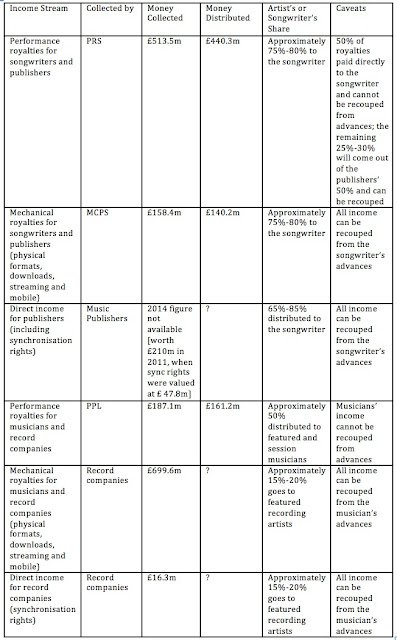
Following on from the previous two blog entries, which took a comparative look at UK collection societies and the income earned by live and recorded music, I’ve made a stab at presenting UK recording and publishing income for 2014.
           The statistics come from a variety of sources and it is risky to contrast them in this manner. In addition, I don’t have privileged access to information. What the figures should help indicate, however, is the relative health of each area. I’ve also made a stab at indicating what proportion of money will go to the songwriter or performing artist albeit that, unless the money is paid to them directly by a collection society, there are plenty of deductions and reductions that can be added to the percentages given in the final column. Significantly and spitefully, I have left out the money from live music, other than performance royalties that PRS collects for songwriters and publishers.


While the collection societies and the British record industries’ trade body BPI are reasonably good at indicating the money that has come into the UK, they are less forthcoming about the money that is leaving. The PRS, MCPS and PPL figures include income that is derived via reciprocal links with foreign collection societies, but they fail to state how much is going in the opposite direction. We don’t know how much money is going to foreign songwriters, publishers, record companies and musicians. Moreover, the record company figures also say nothing about the nationality of the musicians who will be receiving the royalties, nor do they mention the record companies’ countries of origin.
            According to Will Page, there was a time when publishers’ income was divided 40:40:20 between performing, mechanical and synchronisation streams. The figures above would indicate that the split is now divided something like 70:22:8. While this new division highlights the decline of record sales, it distorts the income that can be made from sync rights, which in overall terms has risen considerably in the past few years. In fact, the £47.8m figure given in relation to songwriting sync rights seems like a conservative reckoning, as does the £16.3m for sound recording sync rights. The latter figure comes from IFPI, but in 2011 BPI were regarding this income as nearer to £22m.
While the mechanical royalties for songwriters and publishers are certainly declining, these figures show them to be in better health than some PRS for Music information would have us believe. The PRS for Music Financial Review for 2014 lists recorded music as being worth £63.1m. The higher figure of £140.2m quoted here comes from MCPS’s own Report and Statements and includes the mechanical income that is derived from online licensing and broadcasting income.
            PRS and MCPS generally operate joint licences when it comes to online income (there are also a few minor income streams that are jointly licenced between PRS and PPL). There are no figures available to show how this income is split: PRS for Music instead publish a total figure of £79.7m. This figure is around 22% of the £363.8m that record companies derive from downloads (£249m) and streaming (£115m). The proportion of this money that makes its way to performing artists is much debated.
            But how much money in royalties is going to songwriters and artists overall?  A final, admittedly rough, outcome would reveal something like the following:
  • Performance royalties for songwriters: £374m (roughly two-thirds of which is non-recoupable)
  • Mechanical royalties for songwriters: £119m (recoupable)
  • Sync rights for songwriters: £33m (recoupable)
  • Performance royalties for musicians: £81m (non-recoupable)
  • Mechanical royalties for musicians: £122m (recoupable)
  • Sync rights for musicians: £3m (recoupable)
The money’s in the publishing; it is also in performance.

Friday, 18 September 2015

Broadcast Y'Self Fitter

While it might not be the most exciting game in town, it is instructive to compare the remits of the UK's music collection societies. A Venn diagram would place PRS in the middle. It overlaps with PPL in that it is concerned with the performing right: the income that is derived from the licensing of music to public premises and broadcasters. However, whereas PRS collects this money for songwriters and publishers, PPL collects this money for performers and record companies.
            MCPS overlaps with PRS because it has the same constituency: songwriters and publishers. The money that MCPS collects on their behalf comes from the mechanical licensing of music: the copyright income that arises when songs are reproduced in recorded form, whether this be the sale of physical formats, the broadcast of recorded music on radio and television, the online reproduction of recorded music, the synchronisation of recorded music with moving images or various lesser categories, such as the mechanical reproduction of music in greetings cards. There is no mechanical collection society for performers and record companies. The distribution of money from these sources is something that record companies handle themselves.
            It is appropriate that MCPS and PPL sit at the margins of a Venn diagram, as they collect less money than PRS.  I have written elsewhere about one of the crucial monetary differences between PRS and MCPS. Songwriters and publishers assign the performing right to PRS. The collection society therefore owns this right and collects income from all performance uses. MCPS, in contrast, merely administers the mechanical right. Its members can opt to self-licence the use of their music for films, adverts and some TV broadcasts. Many chose to do so, as the fees that they can extract will be larger than can be derived from MCPS’s blanket licences.
Another crucial difference between PRS and MCPS is the way that money is distributed to songwriters. The standard arrangement at PRS is that 50% of royalties go directly to the songwriter, while 50% of royalties go to the publisher. The songwriter might also receive a share of the publisher’s 50% of royalties: a common deals are for total income to be split 75/25 or 80/20 in the songwriter’s favour. There is nevertheless a difference between the 50% that is paid directly to the songwriter and the 25%-30% of their income that PRS distributes to the publisher. The 25%-30% can be used to pay off the publisher’s advances; the 50% cannot. When it comes to mechanical royalties, a songwriter will enjoy a similar 75/25 or 80/20 split. MCPS distributes its income directly to the publisher, however. Consequently, the entire share that is due to the songwriter can be used to pay off their advances. A songwriter will not receive any mechanical income until these advances have been recouped.
            PPL has similarities with both societies. In response to the European Union’s Rental Directive, it elected in 1996 to distribute 50% of its income directly to performers and 50% to record companies. Here the society parallels PRS in that the artist’s share is safeguarded: it cannot be used to recoup record company advances. This is enshrined in law. In 1996 an amendment was made to the Copyright, Designs and Patents Act concerning the ‘right to equitable remuneration for exploitation of sound recording’. The amendment states that where a recording is ‘played in public’ or is 'communicated to the public' then this performance right ‘may not be assigned by the performer except to a collecting society for the purpose of enabling it to enforce the right on his behalf’. Crucially, this means that artists are not permitted to sign over the performance right in their recordings to their record companies. There is, however, one exception to the 'communication' provisions. Keen readers of updates to the 1988 Act are referred back to the earlier clause 182CA(1), which covers 'electronic transmission in such a way that members of the public may access the recording from a place and at a time individually chosen by them'. This is the 'making available right', which was added to copyright law following the WIPO Treaties of 1996. The electronic transmission being referred to here relates specifically to the online delivery of music. In this sole area of 'communication', performers are not entitled to 'equitable remuneration'. 
            Reflecting this state of affairs, the majority of online income falls outside of PPL's remit. The society’s Annual Review for 2011 states that:
PPL’s online revenues remain limited as the majority of online sound recording licensing is carried out directly by rights owners. This reflects the prevailing view of record companies that downloading and on-demand streaming is analogous to the distribution of sound recordings, a traditional record company function.
Their 2012 Annual Review states:
The scope of PPL’s online licensing rights remains largely limited to online radio, and income from this sector showed further growth in 2O12, albeit from a modest base. The majority of online usage of sound recordings is directly licensed by rightholders and PPL maintains a regular dialogue with its members as to the appropriate extent of PPL’s online licensing.
And in 2013:
The number of small online radio broadcasters licensed by PPL continued to grow, facilitated by the introduction of ‘self-service’ online licensing functionality on the PPL website. Revenue growth from such licensees however, was offset by a decline in revenue from the larger online radio services licensed by PPL, where the market has moved to more interactive online services licensed directly by rightsholders.
The latest Review, for 2014, tells us:
Overall growth in Broadcast & Online licensing income of 1% was delivered in 2014. This was achieved despite increased competition from new online services, which are largely licensed directly by PPL’s members.
What do record companies have to gain by regarding downloading and streaming as analogous to the distribution of sound recordings, on the one hand, or being classified as part of the 'making available right', on the other? First, it means that this income goes directly to the record companies rather than to PPL. Consequently, the money that is due to artists is not safeguarded against their advances: it will instead be used to recoup them. Secondly, it means that the record companies do not have to abide by PPL’s 50/50 rules for splitting income equitably with performers. Many recording artists are, in fact, receiving a far lower percentage of online royalties than this. You’ve probably heard about the fuss they’re making.

Wednesday, 11 February 2015

R4949 Starr


I’ve had a couple books on the go recently and they’ve both had something to say about the status and economic worth of vinyl records. First, there’s The History of Live Music in Britain, Volume 1: 1950-1967, a brilliant collaborative venture between Simon Frith, Matt Brennan, Martin Cloonan and Emma Webster. The book seeks to redress the balance of most accounts of the music industry, which, as the authors rightly point out, ‘over-privilege the recording sector at the expense of the sector in which most musicians in all genres have been located historically: the live arena’.
In the period that this first volume covers even the most well known musicians made more money from touring than they did from recording. The authors quote Gordon Thompson, who states that in the mid-1960s ‘recording contracts provided so little money that a band such as Herman’s Hermits needed to tour because most of their income came from live performance’.
            As so often, what was true of Herman’s Hermits was also true of the Beatles. The second book I’ve been reading is another opening volume: Mark Lewisohn’s Tune In, the first part of his trilogy of books covering the Beatles’ history. The book is unusually forthcoming about recording contracts. It reveals just how little the Beatles stood to earn from their record sales. Lewisohn writes:
the everyday business of management was the stage. No ‘pop stars’ could live off broadcasting fees and only the very biggest of chart stars could live off record royalties, so miniscule were the percentages. No one even tried. The sole object of making records was to attract a bigger profile and so earn higher fees from concert and ballroom shows – and, if the artists were lucky to be chosen, to appear in summer seasons in seaside resorts.
The Beatles’ initial contract with EMI gave them a royalty rate of one penny for each single sold (taking into account both sides of the record). This was payable on only 85% of sales (the other 15% was kept by the record company in lieu of ‘records returned and/or damaged in transit and/or used for demonstration of advertising purposes’). Albums were calculated proportionally, ‘usually as six or seven singles’. The royalty rate was halved for sales outside Britain. Lewisohn does the maths:
In the Beatles’ case, this penny they’d get on 85 per cent of sales would have to be divided five ways: 15 per cent to Brian [Epstein, for his manager’s commission], the rest split between John, Paul, George and Pete [Best]. If they sold a thousand records, they’d get fifteen bob each, and if they ever managed such a famous, gilded, pinnacle-of-career accomplishment as a million-seller, they’d each get £750. If this happened in America – which was, quite obviously, ludicrously unlikely – it would be £375.
He also has the figures for their first EMI royalty statement, which rewarded the band for the sale of 36,868 copies of ‘Love Me Do’. The total received was £130 11s 6d, out of which the Beatles took just £27 15s each. Lennon and McCartney earned more from their songwriting royalties for the single than they did from their record contract. According to Lewisohn, the ‘mechanicals’ for this volume of sales would bring in £325. After Epstein’s 20% commission on this income, this would give the composers £130 each. However, this songwriting income paled in comparison to the money the band was earning from live performance. At the time of ‘Love Me Do’ the Beatles were commanding £50 for each concert appearance.
            And yet it was not live performance that the band venerated, it was records. Here’s Ringo, recalling the experience of seeing ‘Love Me Do’ pressed up as a 45:
[It was] The most momentous moment – that we had a record out, that we had a bit of plastic with us on it. Just the idea of being on a bit of plastic was really incredible after all those years of playing. My God, a record that you hadn’t made in some booth somewhere . . . you don’t believe how great that was.
Ringo, lest we forget, would earn less from recordings than the other Beatles. He wrote the fewest songs. He’s not alone, though, in lauding the moment of seeing yourself on record for the first time. Here’s Keith Richards, talking about the Rolling Stones and their contemporaries:
In a way, in those days, being able to get into the studio and get an acetate back sort or legitimized you. ‘You’re now a commissioned officer’ instead of being one of the ranks.
If only someone would ask him, I’m sure Peter Noone has a similar quote up his sleeve.
            Reading these books made me think about my own work. In Vinyl I argue that one of the distinguishing features of the analogue disc – from the 1880s to the present day – is that it is very difficult to manufacture copies within your own home. This is a format for professionals. As Keith Richards says, it legitimizes you, and it does so in a way that live performance can never do.
            Thus far Ringo and Richards back up my claims. I have paused for thought, however. In the fourth chapter of Vinyl I write about the desire of musicians to escape the commodification process, focusing in particular on the the negative comments rock musicians have made regarding the transformation of their art into serially produced consumer goods. However, it is clear that most musicians (myself included) loved the experience of being pressed into a record for the first time. Consequently, I would now temper my analysis in two ways. Firstly, mass manufacture is not always spurned. There are many artists (and consumers) who place their faith in the most multiplied of products. Jimi Hendrix was amongst them (at least when it came to guitars). According to Charles Shaar Murray:
he seldom bothered with special left-hand models, both because right-handed guitars were more plentiful and easier to obtain, and because – with a touchingly American faith in mass-production – he believed that they were likely to be manufactured to a higher standard.
This depiction of the performer as consumer leads me to the second aspect that I would now change. In the chapter I make a crude distinction between artists and audiences. In doing so, I draw upon the work of Jon Stratton, but I now realise he may have led me up the wrong path. Stratton’s argument is that, in creating a vinyl record
The music is not only commodified; in the process it is also distanced, alienated, from the artist, and becomes an object which is understood to exist in its own right. It moves from the private domain of the artist to the public domain of the market place. Reciprocally, the artist experiences a distancing from his or her music as it becomes product, and is experienced as existing in a different social context. The record company, like a book publisher, acts as a gate-keeper shifting the experienced position of the music from the artist’s individual identification with his/her music to the experiencing of the music as a commodity in the market place.
He suggests that, as this happens, the artists aren’t only distanced from their music; they are distanced from the fans. The musicians stand at one end of a process, their audience is at the other. In between is the apparatus of recordings, gatekeepers and mediation.
He’s clearly right that the music becomes a product and that it exists in a different context. He’s wrong about other things, though. By entering the market place, the music isn’t distanced from the artists: they are consumers too. In fact, one of the reasons why artists are excited about seeing their work on record is because it enters shops in which they have browsed their whole lives. This isn’t alienation; this is coming home.
            What’s interesting to note, though, is that artists’ excitement about the commodity form always seems to come in relation to their first record releases. In the Beatles’ case they each knew by heart the R4949 catalogue number of ‘Love Me Do’. It had become etched into their memories as they had gazed at the record label for so long. And yet, once they had a few releases under their belts, the band members struggled to remember in which order those records were issued or which songs each album contained. Maybe the point at which pop stars become alienated is not when their music is turned into product, but when they stop hanging out in the market.

Monday, 18 August 2014

Words and Music: Doing the Splits


In his book Performing Rites, Simon Frith tells the story of a correspondence between the novelist/lyricist Margaret Radclyffe-Hall and the publishers Chappell and Company, which took place in 1918. Radcylffe-Hall had written the words to the hit song ‘The Blind Ploughman’. She had not received any royalties, however, and wrote to the publishers seeking redress. William Davey, the chairman of Chappell, excused his company’s parsimony on the grounds that:
Unfortunately, we cannot afford to pay royalties to lyric writers. One or two other publishers may, but if we were to introduce the principle, there would be no end to it. Many lyrics are merely the same words in a different order and almost always with the same ideas. Hardly any of them, to be frank, are worth a royalty.
He concedes that he has ‘admiration’ for the words to ‘The Blind Ploughman’ and offers her a one off payment of 20 guineas for her troubles. Frith states that Davey’s ‘letter is interesting in a number of ways, not least for its revelation that Chappell was, apparently, routinely breaking the law – the Copyright Act of 1911 included lyricists in musical composition regulations even though music publishers had campaigned against this’. Frith is alluding to clause 19.2.b.ii of the Act, which states, ‘a musical work shall be deemed to include any words so closely associated therewith as to form part of the same work’. Here, British law was following the Berne Convention of 1886, which sought copyright protection for ‘musical compositions with or without words’.
            Frith is right. It is interesting that Chappell were refusing to pay Radclyffe-Hall. What’s less clear is whether the publishers were breaking the law. If the issue was to do with sheet music, then presumably so: Chappell would have been printing copyrighted words without permission. If the issue was to do with royalties for public performance or for the sale of records (the mechanical right), then things are more complicated. It is mechanical royalties that clause 19.2.b.ii is referring to. Despite the 1911 Copyright Act's recognition of the integral importance of lyrics, however, it set no value on what they were worth. In fact, as far as I am aware, British copyright law has never determined what portion of a song’s performance or mechanical royalties should go to the lyricists and what portion should go to the musical composers. The responsibility for determining these splits was first taken on by music copyright societies. France took the lead here. It established the world's first collection society in 1851. It is of consequence that this society was formed jointly by a lyricist, a composer and a publisher, a partnership that is reflected in its title: Société des auters, compositeurs et éditeurs de musique (SACEM). It was determined that these three parties would share copyright money in equal proportions. When the UK eventually set up its own Performing Right Society (PRS) in 1914, the same split was adopted. Other countries have used different methods, however. The German society, GEMA, originally determined that publishers could have no more than a 25% share. Moreover, while France has retained is three-way split, other countries have moved towards a model where the publisher has a 50% share and the songwriters split the remaining 50% between them (albeit that in private the publisher might also give the songwriters a portion of their share).  
For much of the 20th century, whatever the size of the remaining portion, its most common allocation was to be divided equally between a lyricist and a composer. It was in the inter-war period that much of the ‘Great American Songbook’ was composed. Many of these classic 1920s and 1930s songs were written by partnerships: Harold Arlen and E.Y. Harburg; George and Ira Gershwin; Richard Rodgers and Lorenz Hart; etc. and etc. In each case the former wrote the music and the latter wrote the lyrics, and in each case the composers and lyricists were allocated an equal split of the royalties. The Brill Building songwriting teams of the 1950s and 1960s also operated according to this split, as did the songwriting partnerships in British beat groups. It has been prevalent in musical theatre and has been used by classicist indie songwriters. The idea of a divided split between lyricist and composer is also maintained in much copyright advice.
It has, however, been challenged in a number of ways. One of the problems that traditional splits have presented for self-contained groups is that they are equitable for some members, but not for others. The songwriters will end up richer than the other performers in the band. In many cases the high earners will be the guitarist (who is receiving royalties for writing the music) and the singer (who gains royalties for the words). This disparity has caused bands to split. Alternatively, they might amend their ways. Queen used to allocate songwriting royalties to the principal songwriter of each song, but by the end of their existence were splitting shares for all songs four ways. The Clash were another group who progressed towards presenting their songs as group compositions. Other groups, among them some of the longest-lived, have decided from their inception to allocate shares equally to all members. U2, REM, Coldplay and Elbow all operate in this manner. Others devise more complicated methods. Each member generally receives a royalty share for every track, but these are not allocated equally. The most ‘important’ members (still commonly the singer and the guitarist) will receive a larger allocation. These practices aren't limited to ‘authentic’ guitar bands, either. Some pop acts, such as the Spice Girls and the Sugababes, split their shares between writer/producers and the singers in the group, and the same is true for many solo artists who work with songwriter/producers. In the pop world, too, there is a wide variance in shares. Sometimes they will be split equally, other times more complicated divisions are devised.
Songwriting spits have also been complicated by the practices of sampling and interpolating. Hip-hop tracks, in particular, are a mess of credits. Many, in fact, remain perpetually unresolved. Hip-hop and dance music have also turned traditional musical hierarchies on their head. Where it used to be the case that a song’s melody and words were deemed to be of most value, these genres have seen more credit accorded to the beat. This could be considered an ironic outcome for hip-hop, the most word-based of all popular music forms. It was this genre, however, that shone a light on how unfairly some copyright allocations had been devised. The raps of hip-hop have traditionally rested upon sampled drum breaks. The drummers who devised these breaks have failed to see any royalties for their work. Clyde Subblefield played the famous 'funky drummer' solo, but it's composition credits go to the composer of the song's 'melody', James Brown. Gregory Coleman devised the 'Amen Break', often considered to be the most sampled drum solo of all, and yet the royalties go to Jester Hairston, writer of 'Amen', the song that Coleman's band, the Winstons, were covering. Fewer drum breaks are sampled today. Rhythm tracks are instead created by producers, who will then send these beats to other songwriters so that they can be completed with melodies, harmonies and words. As if mindful of the past injustices meted out to drummers, these producers will demand half of the songwriting royalties. Correspondingly, there are now songwriters who specialize in writing only one part of the song, whether that be the hook or an eight-bar of rhymes.
 There’s something good about these changes. The complexity of pop composition is being recognised and more of the interested parties are receiving some shares. It is also good that popular music copyright is no longer in thrall to classical conventions, with their emphases on melody and harmony over rhythm and timbre. Nevertheless, if the old melodist/lyricist split represented an unfair reflection of the contributors to a work, the new methods fail to bring us any closer to knowing exactly who did what, or towards an understanding of what any of it is really worth.
They also have another consequence. In many cases it is rhythm that is on the rise. When it comes to rock music, the bass players and drummers in bands now appear on more songwriting credits. When it comes to dance music, the producers of rhythm tracks are often the ones who are determining the splits. It is generally assumed that this is happening at the expense of the other musicians, and it is true that many guitarists and keyboard players now receive a lower share of the royalties. There is, however, another activity that is getting squeezed. On the surface, lyrics are still worth 50% of the songwriting shares. If you look at the credits for any song, at least half of the writers' income is going to somebody who is credited as an 'author'. When it comes to popular music, however, few of these writers are only responsible for the words. Most are instead listed as 'composer-authors', meaning that they have an input into both the music and the lyrics. The complicating factor here is that it is not just the main lyric writers who are adopting this credit, in many cases it is being applied to all of the members of a band. It is also being applied to all the members of songwriting teams. And it is being applied no matter how great or small the contribution to the lyric writing is. In fact, there's really no way of checking whether these numerous composer-authors actually contributed to the lyric-writing process. As a consequence, the author who was responsible for writing the majority of the lyrics might well end up with less than 50% of the songwriting share. The composer-author title is reflective of modern songwriting practice. At the same time, it allows songwriters to circumvent the strict 50/50 lyricist/composer split that some of the collection societies require. It has also had another consequence: the composer-author credit has helped to provide longer-lasting copyright protection. But that’s another story for another day . . .