Showing posts with label Recoupment. Show all posts

Wednesday, 4 May 2016

The Loser's Standing Small

Poor Prince. Even in death he is not getting the support he deserves. His 1990s battle against Warner mystified many of his fans. It continues to frustrate some journalists. Here, for example, is Barney Rooney, writing in the Guardian,  ‘It’s difficult not to feel that Prince eventually became his worst enemy. Instead of settling for a role as a treasured cult act, he fought the industry, bit the hands that fed him, and painted “Slave” on his face’. And here is the Independent’s Ben Chu, ‘there has been a lot of purple prose in recent days talking about how Prince valiantly stood up for all musicians with his various battles with record labels. But it’s nonsense. When big acts attack the funding model of record companies what they are doing, whether they know it or not, is pulling up the ladder behind them’.
            There are at least two factors that are coming into play here. One is the record industry’s romantic ideology. It has always been acceptable – even encouraged – for artists to fight against their record companies, but to do so they have to fall on the right side of the art/commerce divide. They receive more sympathy if they are fighting for their musical expression than if they are fighting for their contractual rights. And they receive more sympathy if they are not seen to have done well. The complaints of rich people usually fall on deaf ears.
            And this is where the second factor comes into play. The music business has a famous statistic: only one in ten succeeds. Prince was certainly on the preferable side of this divide. He was among the minority who prospered, while the majority around him failed.
            Unfortunately for Prince, the record industry’s success ratio has been presented in ‘winner takes it all’ terms. This idea goes back at least as far as 1776, albeit that the formula was doubled in those days. In The Wealth of Nations Adam Smith wrote about ‘the exorbitant rewards of players, opera-singers, opera-dancers etc.’ and noted that ‘in a profession where twenty fail for one that succeeds, that one ought to gain all that should have been gained by the unsuccessful twenty’.
This is not how things work in the record industry. The losers are the unprofitable artists who are dropped by their record companies. These artists take nothing, but at least they are not left in debt: their labels waive any money that is in arrears. The winners are those who have achieved profitability. Their gains outweigh the losses of the failures.
However, rather than taking the spoils from the unsuccessful artists, it is the unsuccessful artists who rob the winners of their spoils. Or at least this is the case when it comes to copyright. British law suggests that the owner of sound recording copyright is the party who ‘made and paid’ for the arrangements for the recording to take place. The record companies usually claim this honour, arguing that they draw up the plans for the recordings and they provide the funds.
But they don’t pay for those recordings, artists do. The budgets for recordings are issued in the form of advances. Artists then pay back these advances from their recording royalties. A recouped artist could claim that they have paid for their recording in full.
And yet the record companies still cling on to their copyrights. They defend this practice by referring to their success ratio. The copyrights of the 10% of the artists who succeed are compensation for the debts of the 90% of failures. When it comes to the ownership sound recording copyright it is not the successful artist who takes all; more commonly it is the record company.
It is this practice that Prince was fighting against. He had a right to be hostile. 

Monday, 5 October 2015

Adding up the Publishing and Recording Industries 2014

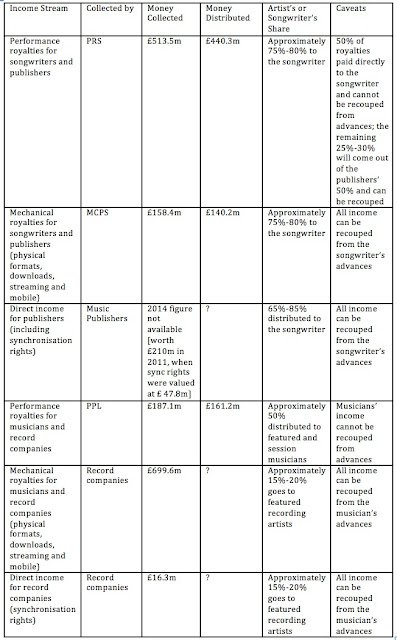
Following on from the previous two blog entries, which took a comparative look at UK collection societies and the income earned by live and recorded music, I’ve made a stab at presenting UK recording and publishing income for 2014.
           The statistics come from a variety of sources and it is risky to contrast them in this manner. In addition, I don’t have privileged access to information. What the figures should help indicate, however, is the relative health of each area. I’ve also made a stab at indicating what proportion of money will go to the songwriter or performing artist albeit that, unless the money is paid to them directly by a collection society, there are plenty of deductions and reductions that can be added to the percentages given in the final column. Significantly and spitefully, I have left out the money from live music, other than performance royalties that PRS collects for songwriters and publishers.


While the collection societies and the British record industries’ trade body BPI are reasonably good at indicating the money that has come into the UK, they are less forthcoming about the money that is leaving. The PRS, MCPS and PPL figures include income that is derived via reciprocal links with foreign collection societies, but they fail to state how much is going in the opposite direction. We don’t know how much money is going to foreign songwriters, publishers, record companies and musicians. Moreover, the record company figures also say nothing about the nationality of the musicians who will be receiving the royalties, nor do they mention the record companies’ countries of origin.
            According to Will Page, there was a time when publishers’ income was divided 40:40:20 between performing, mechanical and synchronisation streams. The figures above would indicate that the split is now divided something like 70:22:8. While this new division highlights the decline of record sales, it distorts the income that can be made from sync rights, which in overall terms has risen considerably in the past few years. In fact, the £47.8m figure given in relation to songwriting sync rights seems like a conservative reckoning, as does the £16.3m for sound recording sync rights. The latter figure comes from IFPI, but in 2011 BPI were regarding this income as nearer to £22m.
While the mechanical royalties for songwriters and publishers are certainly declining, these figures show them to be in better health than some PRS for Music information would have us believe. The PRS for Music Financial Review for 2014 lists recorded music as being worth £63.1m. The higher figure of £140.2m quoted here comes from MCPS’s own Report and Statements and includes the mechanical income that is derived from online licensing and broadcasting income.
            PRS and MCPS generally operate joint licences when it comes to online income (there are also a few minor income streams that are jointly licenced between PRS and PPL). There are no figures available to show how this income is split: PRS for Music instead publish a total figure of £79.7m. This figure is around 22% of the £363.8m that record companies derive from downloads (£249m) and streaming (£115m). The proportion of this money that makes its way to performing artists is much debated.
            But how much money in royalties is going to songwriters and artists overall?  A final, admittedly rough, outcome would reveal something like the following:
  • Performance royalties for songwriters: £374m (roughly two-thirds of which is non-recoupable)
  • Mechanical royalties for songwriters: £119m (recoupable)
  • Sync rights for songwriters: £33m (recoupable)
  • Performance royalties for musicians: £81m (non-recoupable)
  • Mechanical royalties for musicians: £122m (recoupable)
  • Sync rights for musicians: £3m (recoupable)
The money’s in the publishing; it is also in performance.

Friday, 18 September 2015

Broadcast Y'Self Fitter

While it might not be the most exciting game in town, it is instructive to compare the remits of the UK's music collection societies. A Venn diagram would place PRS in the middle. It overlaps with PPL in that it is concerned with the performing right: the income that is derived from the licensing of music to public premises and broadcasters. However, whereas PRS collects this money for songwriters and publishers, PPL collects this money for performers and record companies.
            MCPS overlaps with PRS because it has the same constituency: songwriters and publishers. The money that MCPS collects on their behalf comes from the mechanical licensing of music: the copyright income that arises when songs are reproduced in recorded form, whether this be the sale of physical formats, the broadcast of recorded music on radio and television, the online reproduction of recorded music, the synchronisation of recorded music with moving images or various lesser categories, such as the mechanical reproduction of music in greetings cards. There is no mechanical collection society for performers and record companies. The distribution of money from these sources is something that record companies handle themselves.
            It is appropriate that MCPS and PPL sit at the margins of a Venn diagram, as they collect less money than PRS.  I have written elsewhere about one of the crucial monetary differences between PRS and MCPS. Songwriters and publishers assign the performing right to PRS. The collection society therefore owns this right and collects income from all performance uses. MCPS, in contrast, merely administers the mechanical right. Its members can opt to self-licence the use of their music for films, adverts and some TV broadcasts. Many chose to do so, as the fees that they can extract will be larger than can be derived from MCPS’s blanket licences.
Another crucial difference between PRS and MCPS is the way that money is distributed to songwriters. The standard arrangement at PRS is that 50% of royalties go directly to the songwriter, while 50% of royalties go to the publisher. The songwriter might also receive a share of the publisher’s 50% of royalties: a common deals are for total income to be split 75/25 or 80/20 in the songwriter’s favour. There is nevertheless a difference between the 50% that is paid directly to the songwriter and the 25%-30% of their income that PRS distributes to the publisher. The 25%-30% can be used to pay off the publisher’s advances; the 50% cannot. When it comes to mechanical royalties, a songwriter will enjoy a similar 75/25 or 80/20 split. MCPS distributes its income directly to the publisher, however. Consequently, the entire share that is due to the songwriter can be used to pay off their advances. A songwriter will not receive any mechanical income until these advances have been recouped.
            PPL has similarities with both societies. In response to the European Union’s Rental Directive, it elected in 1996 to distribute 50% of its income directly to performers and 50% to record companies. Here the society parallels PRS in that the artist’s share is safeguarded: it cannot be used to recoup record company advances. This is enshrined in law. In 1996 an amendment was made to the Copyright, Designs and Patents Act concerning the ‘right to equitable remuneration for exploitation of sound recording’. The amendment states that where a recording is ‘played in public’ or is 'communicated to the public' then this performance right ‘may not be assigned by the performer except to a collecting society for the purpose of enabling it to enforce the right on his behalf’. Crucially, this means that artists are not permitted to sign over the performance right in their recordings to their record companies. There is, however, one exception to the 'communication' provisions. Keen readers of updates to the 1988 Act are referred back to the earlier clause 182CA(1), which covers 'electronic transmission in such a way that members of the public may access the recording from a place and at a time individually chosen by them'. This is the 'making available right', which was added to copyright law following the WIPO Treaties of 1996. The electronic transmission being referred to here relates specifically to the online delivery of music. In this sole area of 'communication', performers are not entitled to 'equitable remuneration'. 
            Reflecting this state of affairs, the majority of online income falls outside of PPL's remit. The society’s Annual Review for 2011 states that:
PPL’s online revenues remain limited as the majority of online sound recording licensing is carried out directly by rights owners. This reflects the prevailing view of record companies that downloading and on-demand streaming is analogous to the distribution of sound recordings, a traditional record company function.
Their 2012 Annual Review states:
The scope of PPL’s online licensing rights remains largely limited to online radio, and income from this sector showed further growth in 2O12, albeit from a modest base. The majority of online usage of sound recordings is directly licensed by rightholders and PPL maintains a regular dialogue with its members as to the appropriate extent of PPL’s online licensing.
And in 2013:
The number of small online radio broadcasters licensed by PPL continued to grow, facilitated by the introduction of ‘self-service’ online licensing functionality on the PPL website. Revenue growth from such licensees however, was offset by a decline in revenue from the larger online radio services licensed by PPL, where the market has moved to more interactive online services licensed directly by rightsholders.
The latest Review, for 2014, tells us:
Overall growth in Broadcast & Online licensing income of 1% was delivered in 2014. This was achieved despite increased competition from new online services, which are largely licensed directly by PPL’s members.
What do record companies have to gain by regarding downloading and streaming as analogous to the distribution of sound recordings, on the one hand, or being classified as part of the 'making available right', on the other? First, it means that this income goes directly to the record companies rather than to PPL. Consequently, the money that is due to artists is not safeguarded against their advances: it will instead be used to recoup them. Secondly, it means that the record companies do not have to abide by PPL’s 50/50 rules for splitting income equitably with performers. Many recording artists are, in fact, receiving a far lower percentage of online royalties than this. You’ve probably heard about the fuss they’re making.