Showing posts with label Performing Right. Show all posts

Thursday, 22 February 2018

Measuring the Measuring


In late 2017, UK Music published their latest Measuring Music report. UK Music is a lobbying group for the ‘collective interests of the recorded, published and live arms of the British music industry’. Measuring Music is one of their campaigning documents and it therefore contains headline-grabbing statistics. One of the most eye-catching is that live music is worth £1bn to the UK economy, while recorded music is only worth £640m.
            This phenomenon has been reported in turn by media institutions, such as the BBC and the Financial Times, and by industry players, such the Music Publishers Association, Ticketing Business News and Billboard. It is also noted in the recent UK Live Music Census.
            What these news reports miss out, however, is that that the live music statistics and recorded music statistics are not directly comparable. UK Music admit as much in their separate ‘methodology’ document, albeit only in terms of their calculation of the Gross Value Added (GVA) Contribution, the figures that illustrate the contribution of each music industry sector to the British economy. UK Music state that GVA ‘is most simply understood as the value of sales minus the cost of bought in goods and services used up in the production process’, but also admit that calculating GVA is not straightforward at all. As a result, ‘This means that it is likely that the ratio of GVA to Gross Output that we apply may vary between the different elements of the core music industry. It is bespoke to the core as a whole, not to the component parts of the core’.
            GVA is nevertheless only one of the factors that help to make any direct comparisons between live and recorded music questionable. In fact, the figures are more profoundly skewed by other elements of the methodology, notably decisions about what makes up the ‘core music industry’ and what makes up the ‘wider music industry’; about what to include within each sector of the music industries; and about what to exclude from these sectors. Recorded music suffers in comparison to live music in each of these methodological respects.
            ‘Core music industry’ occupations are counted towards the trade figures; ‘wider music industry’ occupations are not. The core includes live industry revenue from ‘ticketing agents’ and ‘concert venues and arenas’, but it does not include recording industry income from ‘music retail (shops)’, ‘music retail (digital)’ or ‘other music-based digital services for consumers’.
            This discrepancy becomes more apparent when we look at what is included within the ‘recorded music’ sector and what is included within ‘live music’. Recorded music is restricted to the wholesale income of sales of physical formats and downloads, as well as the money that record companies make from streaming (of both the ad-supported and subscription varieties). It does not include the money that the retailers and streaming companies make from selling these goods. The Live music figures, meanwhile, include ‘Total ticket sales for all kinds of live music events’. In contrast to recorded music, they feature the share of income that goes to the retailers of the tickets: ticketing Agents are included. This makes a significant difference. If the retail income from recorded music were included, its totals would rise by at least 30% in the case of the streaming and downloading trade and by around 40% in respect of physical sales. Conversely, ticket agents earn about 10% of the income from ticket sales. On top of this, the live music figures include ‘food and beverage sales’, ‘merchandise’ and ‘venue parking’, as well as ‘camping fees’ for music festivals. It could be argued that recorded music generates similar ‘ancillary’ income (record shops generate merchandise sales and many also now sell food and drink), but these are not included in the figures. The list of trades included under live music is also more expansive. The figures incorporate music festival organisers, music promoters, music agents and production services. Recorded music does include ‘design and production of physical product and packaging’ alongside those employed by record labels themselves. Nevertheless, it does not include the money generated by ‘music producers, recording studios and staff’. These could be considered intimately connected to recorded music, but they are given a separate section within the Measuring Music report.
            There is a more significant omission, however. The live and recorded music figures are concentrated upon those who make a living because of the work of musicians and composers: the record companies, manufacturers, ticket agents and venue workers. The income of the musicians and singers is not included under the headings of recording or live. The policy, instead, is to subtract artist income from these totals and to place it in the combined field of ‘musicians, composers, songwriters & lyricists’. This makes a difference in three respects. In the first instance, it enables the Measuring Music report to argue that artists are the biggest income generators of all. Their total GVA contribution is calculated at £2b. This is double the live income figure and more than three times the amount calculated for recorded music. Secondly, because the figures for composers and performers are combined, we do not get a picture of how much money they are each deriving from recording and how much from live music. This is significant, as we need these figures to get a more accurate picture of the money that is being generated in these two fields. A third factor results from the fact that Measuring Music does not drill down into its figures. We do not get to see how much record companies are earning from recorded music in comparison to recording artists and composers, and nor can we assess the distribution of income in the live music field.
What can be assumed, however, is that the majority of income reported under ‘recorded music’ will result in related income for musicians and composers. They will receive royalties from each sale, download, stream, radio play, public performance or licensing deal. Moreover, while there are variations in the amounts that artists will receive, these are within parameters: approximately 15%-20% of the income from sales and streams will go the recording artists, 8.5% will go the songwriters and their publishers; performing rights relating to the sound recording will be divided 50/50 between record company and musicians, while songwriters will receive at least 50% of the performing rights income for the composition.
            In contrast, there are several income streams reported under ‘live music’ that will not result in corresponding income for performers or composers. In the majority of cases this will include the sales of food and beverages at gigs, the parking income and camping fees, and also the money that venues charge to put on events. Other income figures for live music can be widely variable, including the shares that artists receive from ticket sales and the money that they make from merchandise. The general tendency, however, is that the gap between the rich and poor is wider in live music than it is in recorded music. Live music income is oriented towards star performers and heritage acts, as well as to artists who perform cover versions of these performers songs. Performers down the lower end of the scale may earn nothing from live music or even operate at a loss. Recorded music, in contrast, has a more equal basis. The stars here obviously do make more money than the obscurities, but they do so from generating multiple sales and streams, rather than by charging higher prices than their competitors or by demanding higher fees.
            In one respect UK Music’s decision to separate the income of composers and performers into a category of its own is justified. Although these artists have different income streams for their recorded and live work, the profits and losses in these areas are intertwined. The report depicts a sequential process whereby it is songwriting that enables the creation of successful records, and successful records that prompt successes within live performance. This sequence moves in various directions when it comes to revenue, however. Live performance drives the sale and usage of recordings, and recordings drive the sales of tickets for gigs. Beyond this, as Measuring Music argues, the most successful artists are not just selling their music; they are selling themselves ‘as a brand, reputation or image’.
            At the same time, the categorisations employed by UK Music are of tactical use. As stated above, Measuring Music is a campaigning report. It seeks to gain the government’s support for the UK music industry as a whole. In doing so, it has a dual task. One objective is to point out the value of music. Therefore, the report documents the vast amounts of money that are being accumulated and the large numbers of people who are being employed. At the same time, the report calls for aid. It wants the government to intervene so that yet more money can be made and so that jobs in each sector can be secured.
            UK Music is a coalition between record labels, publishers, artists, managers, songwriters, collection societies and the live music industry. It aims to promote a unified front. It does not want to identify injustices amongst these industry sectors. Therefore, despite the widespread criticism of streaming royalty rates for musicians and songwriters, this report will not show you whether record companies and publishers are profiting at their artists’ expense. Similarly, while prices for tickets have risen sharply in recent years, Measuring Music provides no clues as to whether the live music industry could be more altruistic towards smaller venues or to nascent performers.
Instead, it locates responsibility for low rates of pay outside of the core music industry. As with virtually all industry documents from last year, its main beef is with the ‘value gap’: if there is unfairness in music it is due to YouTube and Facebook and their pesky ‘safe harbours’. Michael Dugher, the CEO of UK Music, stresses that ‘these platforms offer little adequate reward to the investors and creators of the “content”. As a result, their safe harbours must be removed.
The report also suggests that the closure of this value gap within the recording industry will help all parts of the music economy. In doing so, it absolves the live music sector from any responsibility for the distribution of its riches. Dugher notes:
Live music did have another great year as millions of people poured into festivals, stadiums and venues to see and hear their favourite acts. And live music is a fantastic driver for growth. But future talent will never get the chance to shine if we continue to see cuts in music in schools and closures in venues where artists need to learn their craft in the first place. To reach the big stage you need to have a hit record and you need to be able to pay the bills. That means that those who create music and invest in it must be properly rewarded. That’s why we must urgently address the ‘value gap’, particularly on the new and exciting platforms that many people now use to listen to music.
This would appear to indicate that, despite the headline figures about live music’s dominance, when it comes to artists’ recompense it is recorded music that is primary.

Friday, 23 December 2016

It's a Merry Christmas for Songwriters

Songwriters are earning four times as much as recording artists.
            We can reach this conclusion by using the work of Will Page, who is the go-to person for music industries’ statistics. When he worked for PRS for Music he would annually total up the British figures. Now that he is Spotify’s Director of Economics he is performing the same task on a global scale. He has discovered that our planetary music copyright business was worth $24.37bn in 2015. This represents a rise of $941m on 2014.
            In his findings, Page lists the money earned by the record company members of the International Federation of the Phonographic Industry (IFPI); the income of the publisher and composer members of the International Confederation of Societies of Authors and Composers (CISAC); and the money that is going to the publishers directly. The results are as follows:

IFPI digital recordings                           $6.5bn
IFPI physical recordings                        $5.0bn
IFPI performing rights                            $2.1bn
IFPI sync rights                                          $0.3bn
CISAC performing rights                          $6.8bn
CISAC mechanical rights                           $1.2bn
CISAC private copying income                 $0.2bn
Publishing sync rights                                 $0.8bn
Publishing other                                            $0.8bn
Non-CISAC publishing mechanicals          $0.5bn

It is size of the collections and the increase in the money that has attracted headlines. Nevertheless, Page is also keen to point out that there is ‘a misconception about the David-Goliath relationship between labels and publishing’. The publishers are not dwarfed. The overall income for songwriting copyrights is $10.4bn (42.7% of the total), while the income for sound recording copyrights is $14bn (57.3% of the total). According to Page:
When you factored in all the monies that flow to PROs [Performing Rights Organisations], publishers and songwriters, they were much more neck-and-neck in true value than often perceived. However, how that money then flows from firms (labels, publishers and collectives) to individuals (artists and songwriters) is an entirely different conversation.
Page does not enter into this dialogue and it is easy to understand why. It is hard enough getting the total income figures from industry organisations, but at least this information is available. In contrast, the contract details of songwriters and recording artists remain private. As such, it is difficult to determine the percentage royalties that they are receiving from their publishers and record labels. Moreover, these royalties vary from country to country and from artist to artist. These royalties have also varied through time. Songwriters and performers who signed contracts in the 1950s or 1960s, for example, will generally be on lower royalty rates than artists who are signing contracts today.
But the conversation is still worth having. It provides a means of assessing the relative prosperity of songwriters and recording artists. And while the precise details of contracts are not known, some general figures are available. If all artists were on contemporary UK contracts, the splits would look something like this:

Sound Recoding Copyright $14bn
IFPI digital recordings            80%-85% record labels/15%-20% recording artists
IFPI physical recordings         80%-85% record labels/15%-20% recording artists
IFPI performing rights             50% record labels/50% recording artists
IFPI sync rights                        50%-85% record labels/15%-50% recording artists

Songwriting Copyright $10.4bn
CISAC performing rights                           20%-25% publishers/75%-80% songwriters
CISAC mechanical rights                           20%-25% publishers/75%-80% songwriters
CISAC private copying income                  50% publishers/50% songwriters?
Publishing sync rights                                  15%-35% publishers/65%-85% songwriters
Publishing other                                            15%-35% publishers/65%-85% songwriters?
Non-CISAC publishing mechanicals            20%-25% publishers/75%-80% songwriters?

Although some of these splits can only be estimated, these percentages would place the income of songwriters far above that of recording artists. Their take home would be something like $7.75bn, while the overall copyright income for recording artists would only be $2.1bn.
Songwriters would also be in a better position than recording artists when it comes to non-recoupable royalties, the money that cannot be used to pay off advances. At least £3.4bn of the songwriting income would be free from recoupment. In contrast, the only element that would be non-recoupable for recording artists would be the $1.05bn earned from their 50% share of the IFPI performing rights.
            These total figures would have to be reduced, however. At least half of the worldwide copyright income is derived from back catalogue. Consequently, there will be many recording artists and songwriters who are on less favourable percentages than presented here. However, even though the totals for songwriting and recording would come down, there would be an even greater bias in favor of the writers. Old recording contracts tend to be more punitive than old publishing contracts are. The percentages for the artists are proportionally lower and the terms of the contracts last longer. Moreover, songwriters have been guaranteed at least 50% of the performing rights income in most territories for over a century. This is the biggest single income stream and it is non-recoupable. In contrast, recording artists in many countries are still not guaranteed equitable remuneration for performing rights income. Although this 50% share is now mandatory throughout the European Union, this has only been the case since the Rental and Lending Rights Directive of 1992.
            The money is still in the publishing.

Monday, 9 November 2015

It's Not a Game of Monopoly

In an earlier blog entry, I found myself arguing with Lord Macaulay’s famous 1841 speech about the extension of copyright and its impact on the free trade of ideas. Macaulay argued that: ‘Copyright is monopoly, and produces all the effects which the general voice of mankind attributes to monopoly. .... The effect of monopoly generally is to make articles scarce, to make them dear, and to make them bad’.
In contrast, I suggested that music collection societies, which operate as natural monopolies in most countries, produce the opposite effects. Through their blanket licences they help to make music accessible and they sometimes make it cheap. In fact, in their ability to facilitate the business-to-business trade in music, they provide the context in which the public is able to receive a great deal of its music for free. They also help us to access a variety of music, as most of their licensing schemes provide standard rates. Thus it costs users no more to play a Beyoncé record than it does for them to play one Bis.
In addition, I argued that it is those artists who manage to gain individual control over their copyrights who are most likely to commit the evil that Maccaulay describes. It has generally been established and successful performers, such as Taylor Swift, Prince or Thom Yorke, who have managed to escape blanket licensing, whether that is the licensing of a record company or the licensing of a collection society. There are, of course, many positives about the degree of control that they have been able to gain over their careers. This control has nevertheless enabled them to make their work scarce (it doesn’t appear on streaming services) and to sometimes made it dear (as those forced to purchase 1989 on CD will testify).
Collection societies have, in general, been transparent and fairly even-handed. Their licensing schemes are made public and they offer standard terms. There are some injustices, nonetheless. PRS, for example, has had policies that divert income from popular music towards classical repertoire. MCPS, meanwhile, operates licensing schemes that become cheaper the higher up you go. Smaller record companies have to pay licences on the basis of the number of records of manufactured, while larger companies pay on the basis of the number of copies sold. The former have to pay their bills upfront; the latter are invoiced at a later date. Larger companies also pay lower commission rates and benefit from further economies of scale if they use MCPS to licence throughout Europe.
These various concessions don’t compare, however, to the secrecy and inconsistency that surrounds streaming deals. While some artists are escaping monopolies in order not to appear on streaming platforms, record companies and publishers are escaping monopolies in order to deal directly with the same sites. As I have previously documented, record companies maintain that streaming falls under the ‘making available’ right and they believe it is analogous to the sale of sound recordings rather than the broadcast of digital radio. As a consequence they have been able to escape the monopolistic licensing that public performance would entail. They have conducted their own deals with streaming companies and they have avoided the 50% royalty that PPL accords to performing artists.
In some ways, this isn’t a great break with tradition. Record companies have always made most of their deals directly. The same is not true of the publishing companies: the majority of their mechanical and performance licensing has taken place via the monopolistic rates and regulations of the collection societies. By making direct deals with the streaming companies they are entering unchartered waters. And this is precisely what attracts them: they want to escape those collective rules. It’s a complicated business nonetheless. Although record companies have convinced themselves that streaming is largely ‘mechanical’ in nature, the publishing world regards it as being equally divided between the performing and mechanical rights. However, while it is relatively easy for publishing companies to withdraw from MCPS and to self-administer the mechanical right for streaming purposes, they have no such jurisdiction over the performing right. Songwriters assign this right to their collection societies, rather than to their publishers. Consequently, in this area it is the collection societies who have control.
In Europe, the publishers’ solution to this problem has been to form ‘Special Purpose Vehicles’ with the collection societies. These SPVs entitle the publishers to deal directly with streaming companies and secure terms that cover both the performing and mechanical rights. Any terms reached must be agreed by the collection societies, however. Once the royalties have been calculated the income will make its way to artists either via their collection societies (the performing right share, presumably) or directly from their publishers (if this aspect of the mechanical right is escaping the collection societies it will mark another another area of income that is less readily identifiable as recorded music).
The publishers argue that licensing directly enables them to negotiate higher royalties for their artists, as they escape the flat demands of the collection societies. They also argue that this method is more efficient for the streaming companies, as these deals can be completed more quickly and can expand beyond the home country remit of the collection societies. Songwriters are less comfortable. According to the Music Managers Forum many of them would prefer for streaming income to fall under the remit of the collection societies:
possibly because they trust their CMO [collection society] more than their label or publisher; or because payments via CMOs often circumvent contractual terms that enable labels or publishers to retain income; or because they feel collective licensing is fairer to all, because everyone earns the same per play fees, rather than bigger artists or rights owners having a better deal.
Nevertheless, if they are signed with a major publisher, they will find that they have no choice. Sony/ATV has entered into an SPV with PRS and GEMA, Universal has one with SACEM, Warner/Chappel has SPVs with a number of collection societies including PRS, while BMG has a joint venture with GEMA. Meanwhile, Kobalt, who are probably the most innovative publishing company operating today, have actually bought the collection society, AMRA, which they employ to conduct their SPVs.
            And what does this mean for the consumer? In the first instance, it might make some music scarce. Although these direct deals are of potential benefit to the streaming companies because they can licence one publisher for multiple territories, the drawback is that they have to do deals with each publisher individually. Some catalogues may well be left out. These joint ventures might also make music dear. If publishers are able to negotiate higher royalties for their songwriters, then the consumer may well end up paying for them. This could be directly, via subscription charges, or indirectly, via the advertising fees that result from fremium services. In addition, some music might end up being dearer than others, which in turn might make it scarce. The withdrawal from monopoly tumbles on and on . . .  

Wednesday, 21 October 2015

I’ve Been Making Available All My Life

In recent blog entries I have been taking a look at the recording and publishing industries, as well as at mechanical and performing rights. Mechanical rights, which are also known as reproduction rights, incorporate the right to copy a work and the right to issue copies of a work to the public. Performing rights encompass the right to perform to work in public and the right to communicate the work to the public, which includes broadcasting.
In ‘Adding Up the Publishing and Recording Industries 2014’ I stressed the monetary importance of performing right for both songwriters and recording artists. Under PRS for Music rules, songwriters are automatically entitled to 50% of income whenever their song is licensed for performance, whether this be in a live setting or via a broadcast. Similarly, under the ‘equitable remuneration’ rules operated by PPL, recording artists are entitled to 50% of income whenever their recordings are played in public premises or are broadcast on radio or TV. In both cases these royalties are safeguarded: they cannot be recouped from advances.
In ‘Broadcast Y’Self Fitter’ I stressed the difference between classifying digital income as a performance or a mechanical right. If it is regarded as the former, being considered more akin to broadcasting, then artists as well as songwriters can be entitled to as much as 50% of the royalties. If it is regarded as the latter, being instead associated with physical recordings, the recording artist’s royalty rate can drop to something like 15%.
            I’m not alone in having this interest. Since uploading my last blog entry, the Music Managers Forum has published Dissecting the Digital Dollar: How Streaming Services are Licensed and the Challenges Artists Now Face. It is an important document, providing a detailed and lucid account of copyright and royalties in the digital age. It also provides further detail for the case that I have been making.
            One of the best ways to highlight injustices and inconsistencies in respect of royalties is to compare the activities of the collection societies, publishers and record labels. Publishers’ collection societies view the broadcasting of songs as involving both a mechanical and a performance right. In Britain, both the Performing Right Society (PRS) and the Mechanical-Copyright Protection Society (MCPS) have collected income for radio broadcasts. The performing and mechanical rights are present for online licensing as well, whether this is for online radio, downloads or streams. Consequently, the umbrella society, PRS for Music, operates joint licences to capture both of these forms of copyright.
There are differences in the way that income is divided, however. Perhaps understandably, as the format has an affinity with the sales of records in record shops, downloads are regarded as being more mechanical: 75% of royalties collected under the relevant joint licensing scheme go to MCPS and 25% to PRS. Online radio witnesses the reverse: 75% of income goes to PRS and 25% to MCPS. Again, this is understandable, as radio leans more towards the communication right that is enshrined in PRS activity, than it does towards the right to copy, which is patrolled by MCPS. Streaming sits in between: here the money from joint licensing is divided 50/50 between MCPS and PRS. These splits have implications for songwriters. They might receive similar overall shares in each area: for example, both the mechanical and performance income could be divided 75/25 between artists and publishers. As stated above, however, it is only the performance income that is safeguarded against advances: 50% goes directly to the songwriter and cannot be recouped.
If the recording world were to have parity with music publishing, streaming would be regarded as having an equal split between mechanical and performing rights. It would then follow that record companies would collect the 50% of the streaming royalty that relates to the mechanical right themselves. From this income, they would pay their recording artists a similar royalty to their income for physical sales: this would result in a new recording artist receiving an approximate 15% share. The recording artist should do better when it comes to the performing right. 50% of streaming income would be collected by the relevant performing right society, which in the UK is Phonographic Performance Ltd (PPL). This income would itself then be split 50/50, with half going to the record company and half to the recording artist.
But this doesn’t happen. Record companies collect the whole of the streaming income. According to PPL’s own literature, the labels regard both downloading and streaming as involving the mechanical right only. Their 2011 Annual Report states:
PPL’s online revenues remain limited as the majority of online sound recording licensing is carried out directly by rights owners. This reflects the prevailing view of record companies that downloading and on-demand streaming is analogous to the distribution of sound recordings, a traditional record company function.
Running somewhat counter to this argument, the record companies’ also claim that recording artists are not entitled to ‘equitable remuneration’ when it comes to downloading and streaming because this is an area in which performing rights operate differently.
            Here they refer to the ‘making available’ right, which was formulated during World Intellectual Property Organisation treaties of 1996 and enshrined in EU law in 2001. Dissecting the Digital Dollar outlines the origins of this right:
the communication control, where defined in copyright law, traditionally related to conventional broadcasting which, while easily extended to webcasting, might not apply to other kinds of digital transmission. To ensure digital communication of this kind would still be restricted by copyright, and perhaps to distinguish it from the existing controls that covered broadcasting, some rights owners lobbied to have a separate control added to copyright law called ‘making available’.
The activity controlled by this law is ‘electronic transmission in such a way that members of the public may access the recording from a place and at a time individually chosen by them’. As such, it clearly encompasses downloading, but does not encompass online radio (as a result online income in this area is collected by PPL). The record companies believe that the ‘making available’ right encompasses streaming as well. However, as the MMF report states, ‘not all artists agree’ with this point of view. As illustrated by the way that the publishing sector deals with streaming income, this activity can be regarded as akin to both broadcasting and to record sales.
            Why does any of this matter? ‘Making available’ is the only area of sound recording performance rights that is exempt from ‘equitable remuneration’. Consequently, artists are not guaranteed 50% of this income. Instead, it can be collected by record companies directly and some artists will therefore be on a standard royalty rate as low as 15%. What is more, any royalties collected can be recouped from advances.
            Dissecting the Digital Dollar includes a survey conducted with artist managers. Their responses to two questions are particularly telling. 78% of respondents believed that equitable remuneration should exist for all digital services, including both downloads and streams. However, when asked if they know how collection societies proportion streaming income according to the mechanical right and the performing right, only 3% replied in the affirmative.  

Monday, 5 October 2015

Adding up the Publishing and Recording Industries 2014

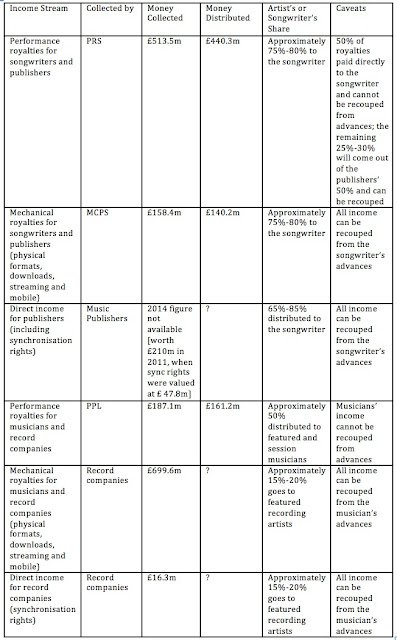
Following on from the previous two blog entries, which took a comparative look at UK collection societies and the income earned by live and recorded music, I’ve made a stab at presenting UK recording and publishing income for 2014.
           The statistics come from a variety of sources and it is risky to contrast them in this manner. In addition, I don’t have privileged access to information. What the figures should help indicate, however, is the relative health of each area. I’ve also made a stab at indicating what proportion of money will go to the songwriter or performing artist albeit that, unless the money is paid to them directly by a collection society, there are plenty of deductions and reductions that can be added to the percentages given in the final column. Significantly and spitefully, I have left out the money from live music, other than performance royalties that PRS collects for songwriters and publishers.


While the collection societies and the British record industries’ trade body BPI are reasonably good at indicating the money that has come into the UK, they are less forthcoming about the money that is leaving. The PRS, MCPS and PPL figures include income that is derived via reciprocal links with foreign collection societies, but they fail to state how much is going in the opposite direction. We don’t know how much money is going to foreign songwriters, publishers, record companies and musicians. Moreover, the record company figures also say nothing about the nationality of the musicians who will be receiving the royalties, nor do they mention the record companies’ countries of origin.
            According to Will Page, there was a time when publishers’ income was divided 40:40:20 between performing, mechanical and synchronisation streams. The figures above would indicate that the split is now divided something like 70:22:8. While this new division highlights the decline of record sales, it distorts the income that can be made from sync rights, which in overall terms has risen considerably in the past few years. In fact, the £47.8m figure given in relation to songwriting sync rights seems like a conservative reckoning, as does the £16.3m for sound recording sync rights. The latter figure comes from IFPI, but in 2011 BPI were regarding this income as nearer to £22m.
While the mechanical royalties for songwriters and publishers are certainly declining, these figures show them to be in better health than some PRS for Music information would have us believe. The PRS for Music Financial Review for 2014 lists recorded music as being worth £63.1m. The higher figure of £140.2m quoted here comes from MCPS’s own Report and Statements and includes the mechanical income that is derived from online licensing and broadcasting income.
            PRS and MCPS generally operate joint licences when it comes to online income (there are also a few minor income streams that are jointly licenced between PRS and PPL). There are no figures available to show how this income is split: PRS for Music instead publish a total figure of £79.7m. This figure is around 22% of the £363.8m that record companies derive from downloads (£249m) and streaming (£115m). The proportion of this money that makes its way to performing artists is much debated.
            But how much money in royalties is going to songwriters and artists overall?  A final, admittedly rough, outcome would reveal something like the following:
  • Performance royalties for songwriters: £374m (roughly two-thirds of which is non-recoupable)
  • Mechanical royalties for songwriters: £119m (recoupable)
  • Sync rights for songwriters: £33m (recoupable)
  • Performance royalties for musicians: £81m (non-recoupable)
  • Mechanical royalties for musicians: £122m (recoupable)
  • Sync rights for musicians: £3m (recoupable)
The money’s in the publishing; it is also in performance.